
If you've kept chickens for more than a season, you already know the ritual. You walk toward the run with something in your hand and the whole flock loses their minds before you've even lifted the latch. Dried mealworms have been the go-to chicken treat for years. They're everywhere, the hens adore them, and the protein numbers look good on paper. But a few months ago I started digging into why my older hens were still cracking the occasional thin-shelled egg even though I had oyster shell in front of them around the clock. That research led me straight to black soldier fly larvae, and the calcium comparison alone made me swap bags that same week.
This comparison covers what actually matters for a backyard flock: protein, calcium, fat, sustainability, cost, and a sourcing wrinkle with dried mealworms that most chicken keepers have never heard of. Adaman's dried BSFL is the brand I've been running with, and I'll tell you exactly why it landed at the top of my feed shelf.
| Category | Adaman Dried BSFL | Dried Mealworms |
|---|---|---|
| Protein (dry weight) | ~42% | ~53% |
| Calcium content | ~9,340 mg/kg | ~108 mg/kg |
| Fat content | ~35% | ~28% |
| Calcium-to-phosphorus ratio | Favorable (closer to balanced) | Inverse (high phosphorus blocks calcium absorption) |
| FDA import status | No current import concerns | Subject to FDA detention orders (many Chinese imports) |
| Sustainability | Upcycled organic waste, low land/water use | Higher land and water footprint |
| Typical price per pound | Lower (5 lb bags common) | Higher per ounce at same quality level |
| Flock response | Stampede-level enthusiasm | Stampede-level enthusiasm |
| Shell thickness benefit | Strong: high calcium, good ratio | Weak: low calcium, poor ratio |
| Amazon link available | Yes (Adaman, ASIN B097QDK841) | No specific brand recommended |
Where Adaman BSFL Wins
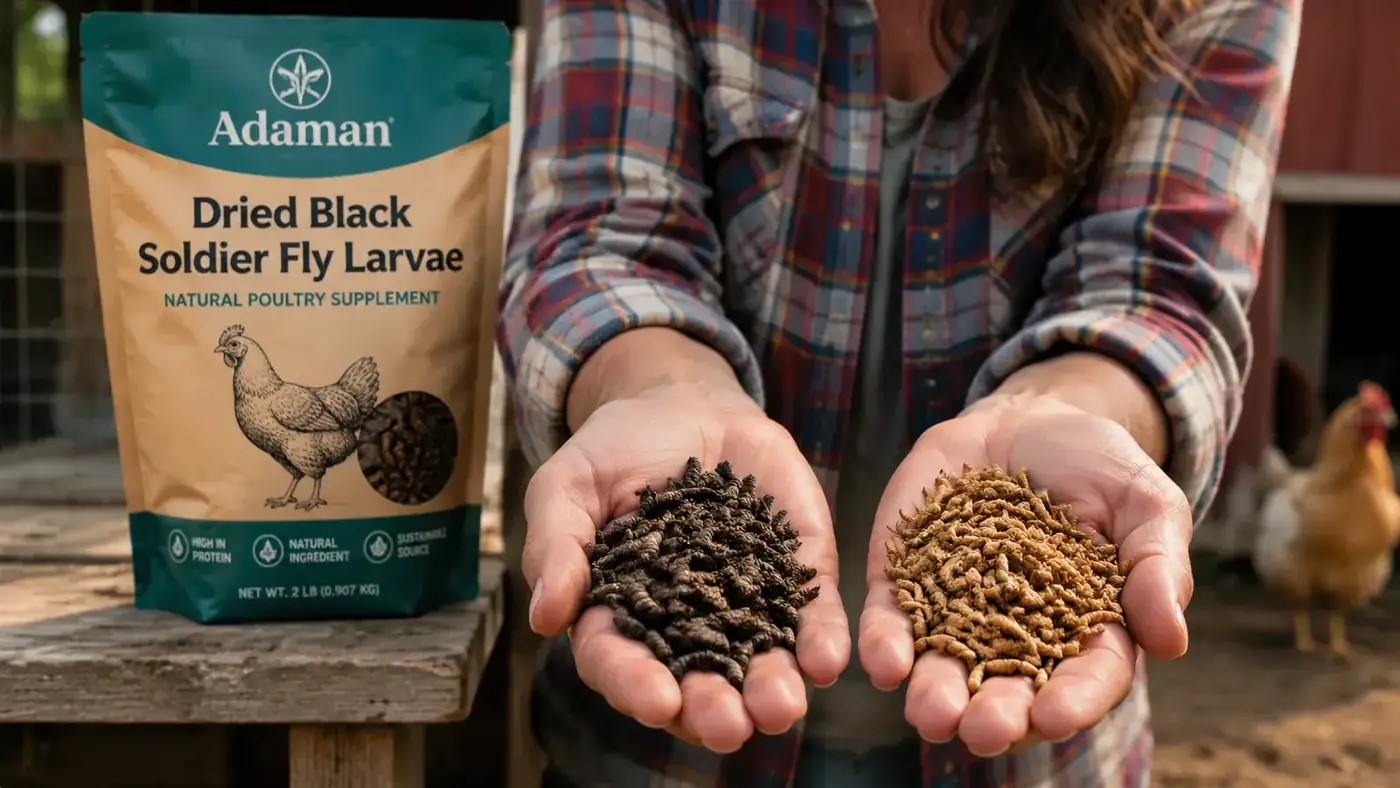
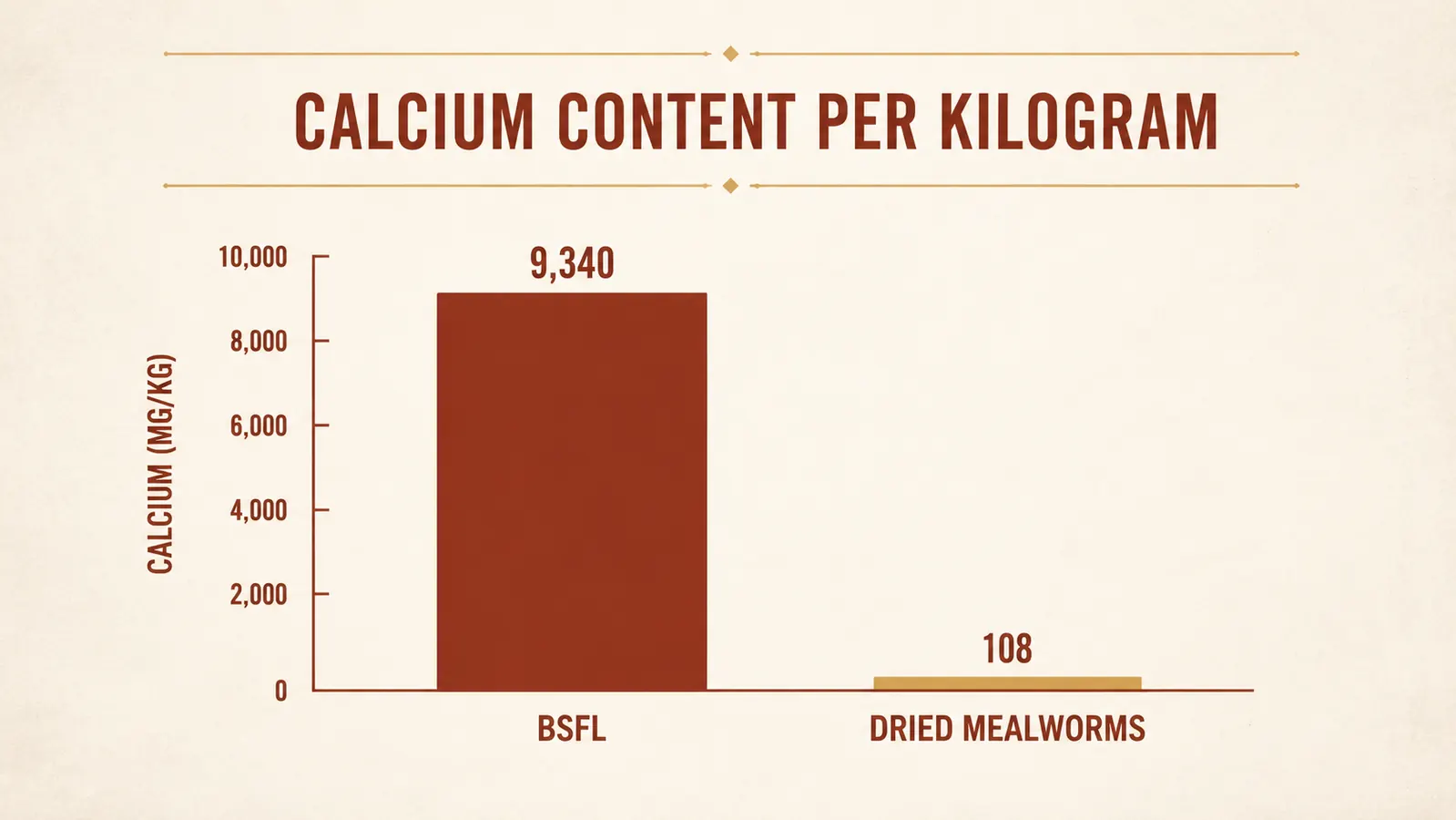
The calcium story is the biggest surprise for most keepers, and it surprised me too. Dried mealworms clock in around 108 milligrams of calcium per kilogram. Dried black soldier fly larvae come in at roughly 9,340 milligrams per kilogram. That is not a rounding difference. That is an entirely different category of feed input. If your hens are laying thin-shelled eggs, no amount of mealworms will fix that. BSFL will actually move the needle, and you will notice it within two to three weeks of consistent feeding.
It's not just raw calcium either. Mealworms have an inverted calcium-to-phosphorus ratio: they're high in phosphorus, which actively competes with calcium absorption in the gut. So even the modest calcium that is in mealworms gets partially blocked. BSFL have a much more favorable ratio, meaning the calcium your hens consume actually makes it where it needs to go. This is why keepers who switch report improvements in shell thickness that oyster shell alone wasn't delivering. The Adaman bag I use is 5 pounds, rated 4.7 stars across 3,414 reviews, and costs less per feeding session than comparable mealworm bags when you do the math on how much you need per hen.
On protein, BSFL comes in around 42%, compared to mealworms at roughly 53%. Mealworms do win that round on paper. But protein alone is not the whole story for laying hens. A hen working through molt or recovering from a respiratory round can benefit from a high-protein top-dress, and either treat handles that. For everyday flock maintenance, 42% protein from BSFL, stacked with the calcium advantage and the better fat profile, is a more complete contribution per gram of treat.
Where Dried Mealworms Win
Protein is the one category where dried mealworms genuinely come out ahead. At 53% protein by dry weight, they're a meaningful bump above BSFL's 42%. If you have hens in hard molt, where feather regrowth is pulling heavily on protein reserves, a short high-protein push with mealworms makes sense. Feathers are about 85% protein, and a hen regrowing a full cape of feathers in October needs every gram she can get.
Mealworms also have a longer track record in the backyard chicken community. Keepers have been feeding them for two decades, the dosing guidance is well established, and most chicken-keeping books and online communities default to them. If you already have a 5-pound bag in the pantry, there is nothing wrong with finishing it. The issue is when mealworms become the everyday treat and keepers expect them to do the work that only BSFL can do on shells and calcium.
The FDA Import Situation: What Mealworm Buyers Need to Know
This is the part most chicken-keeper content skips over, so I want to spend a minute here. The majority of dried mealworms sold on Amazon and at farm stores are imported from China. The FDA has issued automatic detention orders on mealworms from multiple Chinese exporters due to sanitary concerns and documentation violations. That doesn't mean every bag you pick up is contaminated, but it does mean quality and safety consistency across brands varies significantly. The FDA detention list is a public document, and a surprising number of popular mealworm brands have appeared on it.
Black soldier fly larvae like Adaman's are typically domestically raised or sourced from suppliers with cleaner supply chains. The BSFL industry is newer and has grown up with more scrutiny. If you are the type of keeper who reads labels and researches sourcing, the mealworm import situation is worth a five-minute search before your next order. I'm not trying to scare anyone off mealworms entirely. I am saying that when the nutritional case for BSFL is already this strong, the sourcing question tips the scale further.
The calcium numbers aren't even close. Mealworms have 108 mg per kilogram. BSFL have 9,340. When my older girls were cracking shells, this is the number that changed everything.
Cost Comparison: Does BSFL Actually Cost More?
Common assumption: mealworms are the cheap treat and BSFL are the premium upgrade. My experience is the opposite once you run the per-feeding math. A 5-pound bag of Adaman BSFL carries a current price that comes out to less per ounce than most quality mealworm bags in the same size range. More importantly, because BSFL delivers more nutritional benefit per gram fed, you don't need to feed as much to achieve the same effect. A small palmful per bird a few times a week is plenty. Keepers who switch from mealworms often find they're spending less over a month, not more.
The 5-pound bag size is also practical for backyard flocks. I have six hens and a bag lasts me close to three weeks at a conservative feed rate. For a small flock, that's a very manageable spend for the shell quality improvement you get in return.
Your hens are going to beg for both. Only one fixes thin shells.
Adaman's dried BSFL is 5 lbs of 100% natural black soldier fly larvae with 85x more calcium than mealworms. Rated 4.7 stars across 3,414 reviews. Check today's price and see if it's right for your flock.
Amazon Check Today's Price on Amazon →Sustainability: A Real Difference, Not Just Marketing
Black soldier fly larvae are raised on organic waste, which means food scraps, agricultural byproducts, and material that would otherwise go to landfill. They require a fraction of the land and water that conventional insect farming or grain-based feed production demands. If the environmental angle matters to you, BSFL is the cleaner choice. Mealworms require grain inputs and more land per pound of output. Neither is a major environmental concern at backyard-treat scale, but for keepers already keeping chickens partly because they want a more regenerative homestead, BSFL fits the philosophy better.
How to Feed Each: Dos and Don'ts
For BSFL, the general guidance is to treat them as a supplement, not a feed replacement. The 90/10 rule applies: 90% complete layer feed, 10% treats total. A small handful per bird, two to four times a week, is plenty for the calcium benefit without throwing off your feed balance. I sprinkle them on top of a little scratch grain so the more timid hens get their share before the pushy ones clean up. You can also scatter them in the run to encourage natural foraging behavior.
Mealworms follow the same 90/10 rule. The one mistake keepers make with mealworms is feeding too freely during molt, which is exactly when hens need them most. A generous treat hand is fine, but if your hens start preferring treats over their complete layer feed, pull back. I've seen flock keepers wonder why egg production dipped in fall, and the answer was often a five-pound mealworm bag going through in two weeks. Moderation applies to both treats.
Who Should Buy Which
Buy Adaman BSFL if your priority is eggshell quality and everyday flock nutrition. If you have older hens, heritage breeds with heavier bodies, or any bird that's been laying thin or wrinkled shells despite adequate oyster shell access, BSFL is the upgrade that will actually change what you see. It's also the right call if you want to simplify your treat lineup, since BSFL handles both the protein and calcium angles well enough to be a one-bag solution.
Reach for dried mealworms when you have hens in active, hard molt who need a short burst of maximum protein. During molt, feather regrowth demand spikes, and the extra few percentage points of protein mealworms carry can make a visible difference in how fast birds come back into full feather. If I had to have both bags on the shelf, I'd use BSFL as the everyday treat from spring through fall and pull out the mealworms for October and November when the molt is at its most brutal. That combination covers every season your flock cycles through.
If thin shells have been bothering you, BSFL is the fix that actually works.
Adaman dried black soldier fly larvae: 5 lbs, 4.7 stars, 3,414 reviews, and 85x more calcium than the mealworms probably already on your shelf. Check today's price before you reorder the old bag out of habit.
Amazon Check Today's Price on Amazon →