
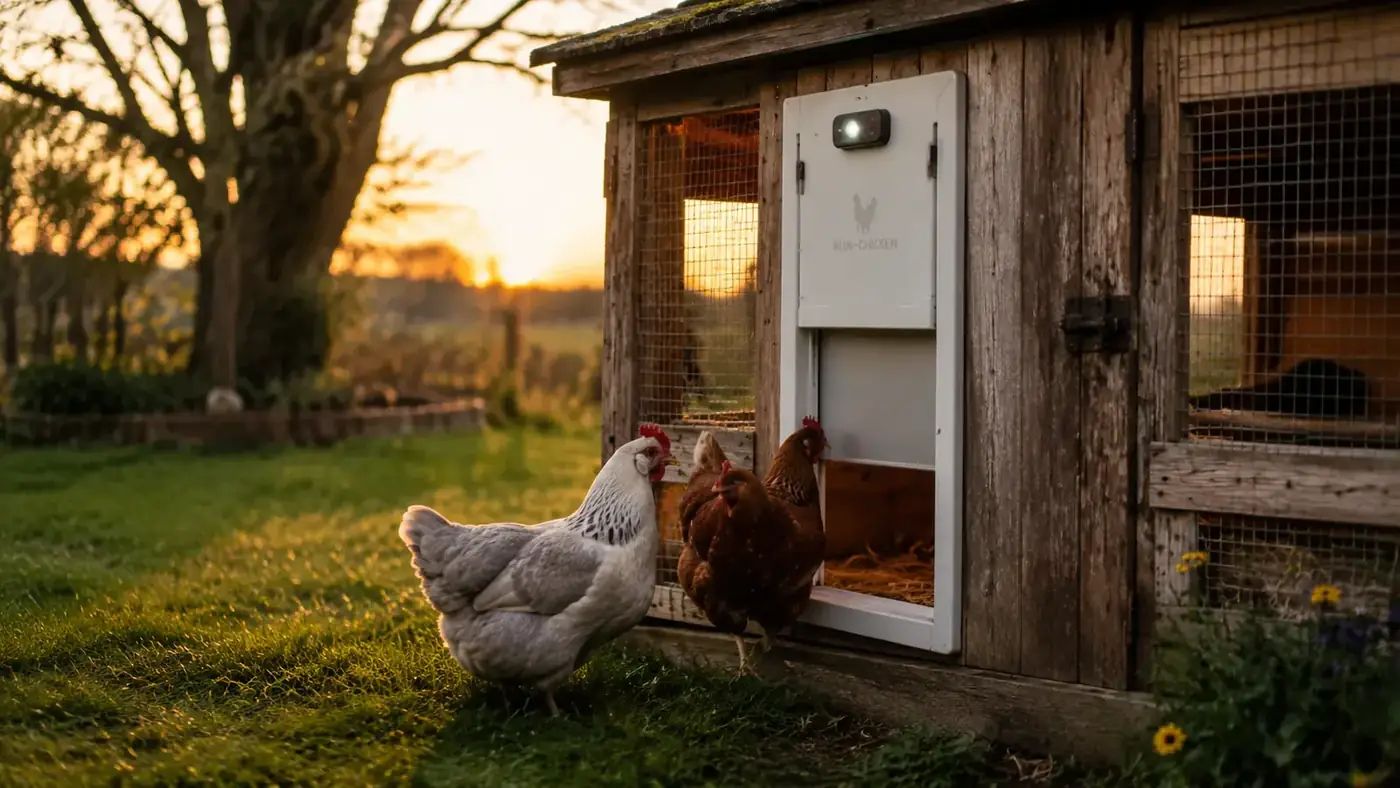
The morning I finally bought a RUN-CHICKEN T50 was not a rational decision. It was 5:43 a.m. on a Tuesday in October and I was standing in my backyard in rain boots and a bathrobe, unlocking the coop in the dark because I had overslept and Maple, my most vocal Barred Rock, was already sounding like a smoke alarm. My husband stood in the kitchen window with his coffee and said absolutely nothing, which was somehow worse than if he had said something. I ordered the T50 from my phone before I even went back inside.
I have had it mounted on my six-hen coop for fourteen months now. The flock is Maple and Dot, my two Barred Rocks, Fern and Clover, my Easter Eggers, and Biscuit and Rue, a pair of Buff Orpingtons I added last spring. In that time, I have not manually closed the coop door a single night. Not once. That fact alone would have gotten five stars from me, but I want to give you the full picture, including the winter quirk that genuinely scared me and the one setting tweak that changed everything.
The Quick Verdict
The T50 does one thing , lock up your coop automatically every night , and after 14 months of real use it does it reliably enough that I would buy it again without hesitation. The light sensor needs a small learning curve, and deep cold shortens battery life more than the box implies, but neither issue is a dealbreaker.
Amazon Check Today's Price →Tired of sprinting to the coop every evening before dark? The T50 handles it for you.
The RUN-CHICKEN T50 runs on 4 AA batteries, mounts in under 30 minutes, and opens and closes on light alone , no WiFi, no app, no timer to reset when daylight saving flips. Current pricing on Amazon is below what I paid at installation.
Amazon Check Today's Price on Amazon →How I've Used It: The Setup and the First 90 Days
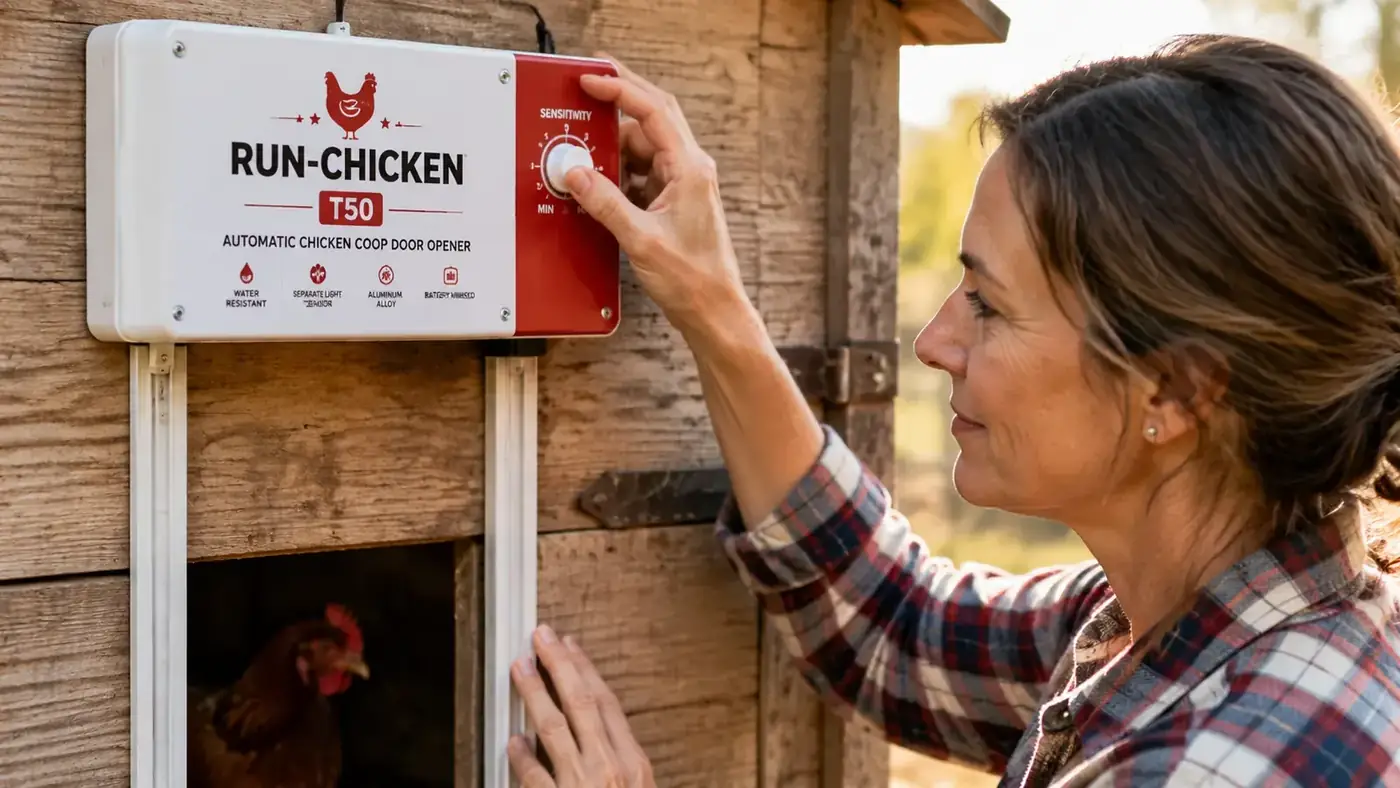
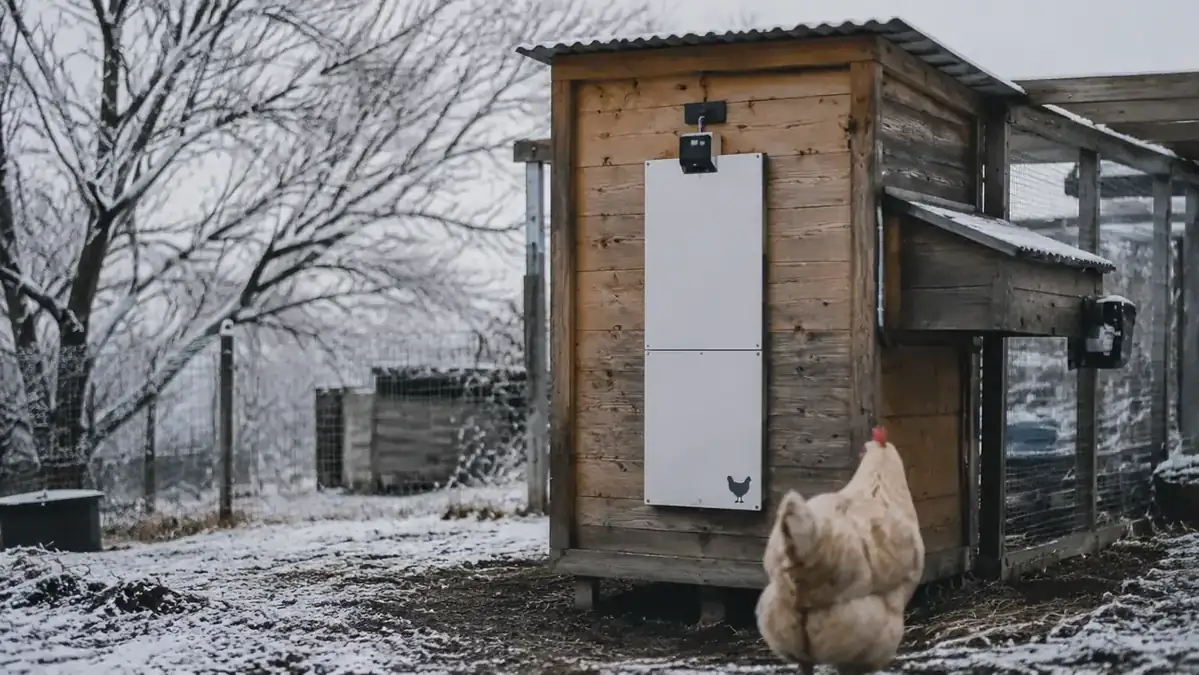
Installation took me about twenty-five minutes, not counting the ten I spent reading the instructions twice because I was convinced I was missing something. The door slides vertically in an aluminum track system that you screw directly to the coop face. You drill a small hole for the door panel to pass through, attach the motor housing on top, and drop in four AA batteries. The whole unit is self-contained, which I appreciated because my coop has no electricity run to it. No timer to program, no app to pair. The sensor reads ambient light and the adjustment dial controls how bright or dim the surroundings have to be before the door moves.
The first week I obsessively checked the coop after dark to confirm it had actually closed. It had. Every night. I adjusted the sensitivity dial once, a quarter turn counterclockwise, because the door was closing a little earlier than I wanted and Fern was not always back inside before it dropped. After that single tweak it has not needed to be touched. The door opens in the morning shortly after first light and closes in the evening shortly after the hens have gone to roost. That is more or less the complete setup story.
What Changed After Six Months
By month four I had completely stopped thinking about the coop door. That sounds like nothing, but if you have chickens you know the mental tax of door management. Every late dinner, every evening walk, every trip that runs past sundown involves a small internal calculation: is the coop closed? The T50 removed that calculation entirely. I started sleeping past 6 a.m. on weekends for the first time in two years. Maple still woke me up sometimes anyway, but that is a Maple problem, not a coop problem.
Around month six I also noticed something I had not expected: the hens trained themselves around the door. Dot, who used to be the last hen in at night, started hustling to the coop more reliably once the door had established a consistent routine. Chickens genuinely learn the schedule. If you have a hen that free-ranges and sometimes lingers outside too long, the T50 does apply low-level pressure in the right direction.
The one issue I hit at around month seven was that Biscuit, my dominant Buff Orpington, started blocking the doorway during the evening close, which meant the door's obstruction sensor would stop it mid-descent and it would reverse back up. The T50 has a safety sensor that prevents it from crushing a chicken, which is absolutely the right design choice, but it meant Biscuit was effectively holding the door open while she decided if she was ready to go in. I solved this by moving the feeder inside the coop, which gave Biscuit a reason to go in before the door started closing. Problem gone.
Winter Performance and Battery Life in the Cold
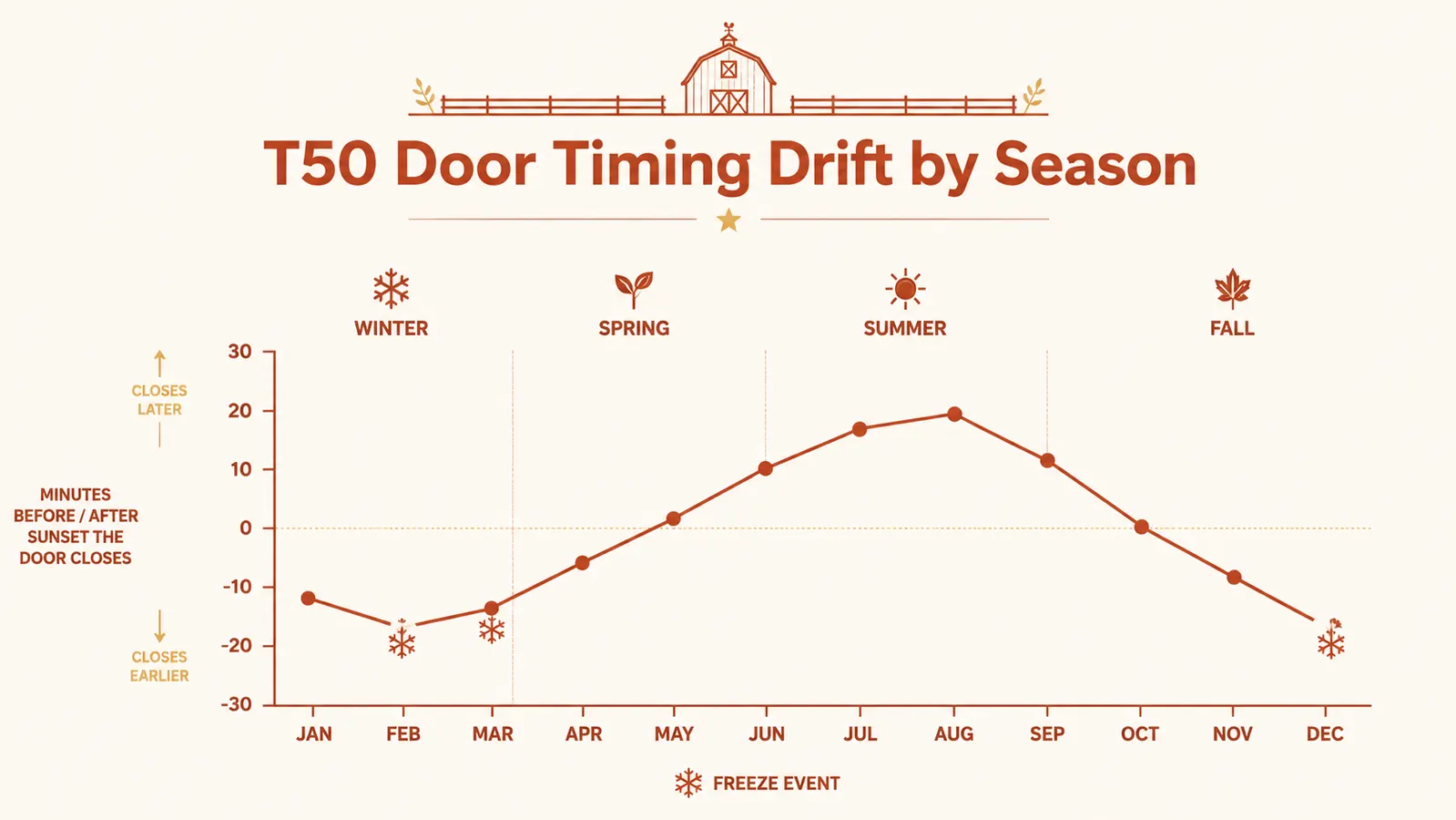
Here is where I want to be straight with you, because the marketing is a bit optimistic. The T50 is marketed with battery life in the range of several months per set. In mild fall weather, I changed batteries once every four to five months, which felt about right. When temperatures dropped below 20 degrees Fahrenheit in January and February, battery life dropped noticeably. I went through a full set in about six weeks during the coldest stretch. Cold kills alkaline batteries faster than the spec assumes. Switching to lithium AA batteries helped considerably. On lithium I got closer to three months even in hard cold, and the door motion felt crisper in sub-freezing temps. If you are in a cold climate, budget for lithiums and skip the cheap alkalines.
The door itself handled the cold fine. We had three nights where it hit minus 8 and the door opened and closed both mornings and evenings without hesitation. The aluminum track does collect light frost, but not enough to bind the door panel. I did notice that on one morning after an ice storm, the door was about a quarter-inch off full open, just enough to make me nervous but not enough to actually block a hen. A quick manual push freed it and it has not happened since. Not a pattern, more of a one-time ice event.
I went through a full battery set in six weeks during our coldest stretch. Switch to lithium AAs in winter. That one change stretched my battery life back to three months even in hard cold.
Predator Close Calls: What the Door Bought Me
I want to tell you about the night in late September. I was in the house around 9 p.m. when I heard Maple make a sound I had not heard before, a low repetitive alarm call she does not do for wind or cats. I grabbed my headlamp and went outside. A raccoon was working the run fence about fifteen feet from the coop. The coop door had been closed for over two hours at that point. The raccoon was clearly interested in getting inside but could not figure out an entry point into the run. It wandered off after a few minutes.
I have thought about that night a lot. Before the T50, my old manual wooden coop door had a simple hook-and-eye latch that I was not always diligent about. A determined raccoon has no trouble with a hook latch. The T50's aluminum door is a different proposition. It drops into a track on both sides and there is no external handle to grab or flip. Is it impenetrable? Nothing is. But it is meaningfully harder to open than a wooden panel with a hook, and it was closed before full dark, which is the window when I used to sometimes be five or ten minutes late. I lost a hen to a fox the year before I got the T50. I have not lost one since. I cannot prove causation, but I am not inclined to go back to manual.
Dawn and Dusk Behavior: The Sensor in Practice
The light sensor is the heart of this product and it is worth understanding how it actually behaves before you buy. It does not open and close at a fixed clock time. It responds to ambient light, which means it adjusts naturally to the seasons without any action from you. In June my door opens around 5:20 a.m. and closes around 8:45 p.m. In December it opens closer to 7:10 a.m. and closes around 4:50 p.m. Those times shift gradually as the season changes, and I never had to touch a timer or setting to make it happen. If you have run automatic lights on a timer and dealt with adjusting them for daylight saving time, you will appreciate this.
The one scenario where the sensor behaves oddly is heavy overcast days. If it is genuinely dark outside at 11 a.m. because of thick storm clouds, the door can close unexpectedly. I have seen it happen twice, both times during winter storms. Both times the hens were inside anyway because they refuse to go out in heavy rain, so no harm done. But it is worth knowing. If you have hens that free-range in a covered run and you depend on the door to stay open during a grey day, the light sensor approach is not foolproof.
What I Liked
- Genuinely set-it-and-forget-it once the sensitivity dial is dialed in
- No WiFi, no app, no timer, no daylight saving adjustment needed
- Light sensor adapts to seasonal changes automatically
- Obstruction safety sensor reverses before it can harm a hen
- Aluminum door and track feel solid, hold up to fourteen months of daily use
- Battery-powered installation works with any coop, no electricity needed
Where It Falls Short
- Battery life drops significantly in cold below 20F, alkalines are optimistic
- Heavy overcast can trigger early close on dark storm days
- Sensitivity dial has no numbered markings, dial-in requires trial and error
- Blockage sensor means a stubborn hen can hold the door open indefinitely
The One Setting I Wish I Had Known About Day One
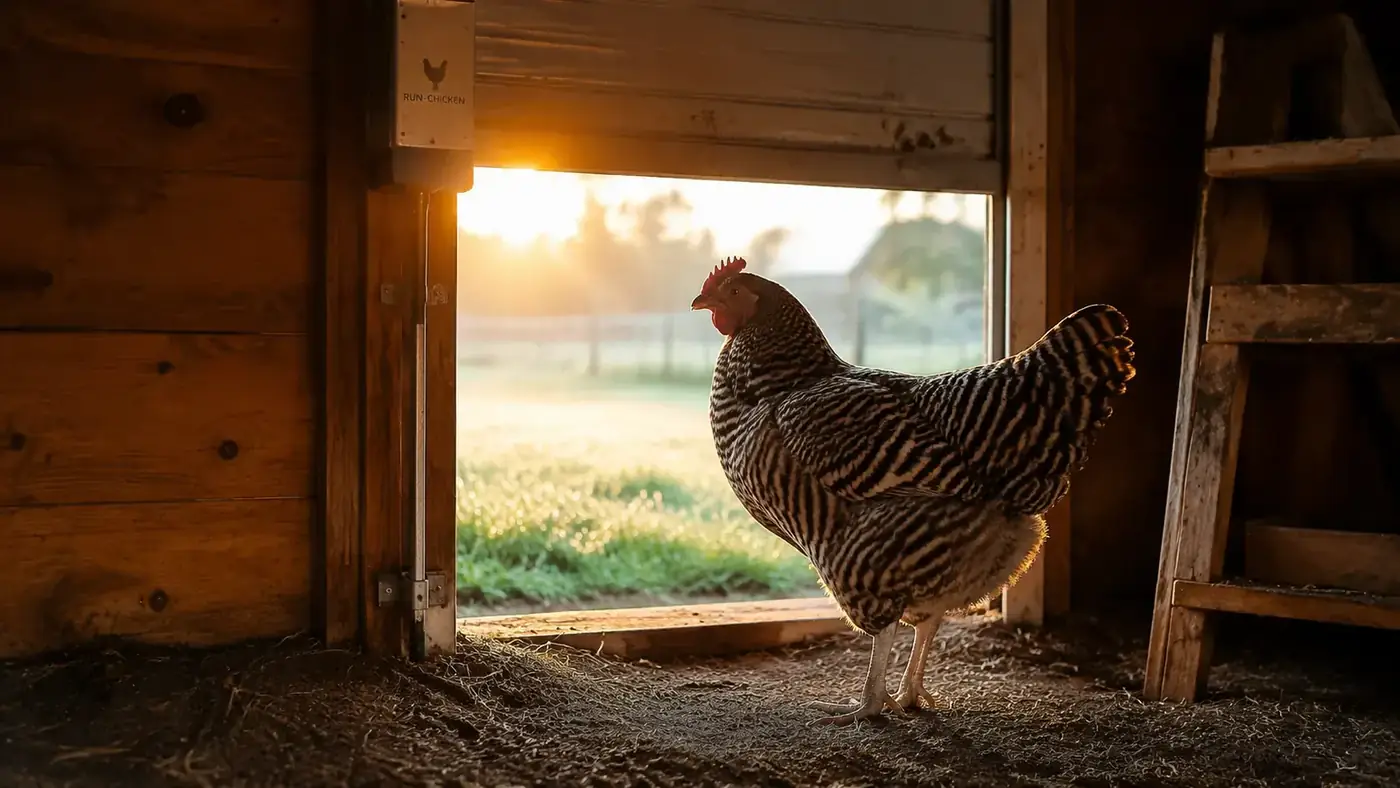
The sensitivity dial controls how much ambient light triggers the motor and it is the most important adjustment on the unit. The problem is it has no numbered markings, just a range from one end to the other. RUN-CHICKEN's instructions suggest a starting position but every installation is different based on where your coop faces, what trees are nearby, and whether you have any exterior lights that bleed onto the sensor. My coop faces west, which means it catches the last of the sunset light longer than an east-facing door would. My initial setting was causing the door to close while two of my hens were still scratching around in the run.
The fix was a small counterclockwise turn. I did it once, watched three evenings, and it has been right ever since. The learning process takes about a week of observation, not because the product is difficult, but because you need to watch it across a few different light conditions to confirm you have the right position. Budget that week of attention into your expectations. After that, you will probably never touch it again.
How It Compares to What I Tried Before
Before the T50 I used a basic rope-and-pulley system I built myself, the kind you can rig with a piece of paracord and a carabiner, where you pull a line from inside the house to raise and lower the door. It worked when I was home and awake at the right times, which is not always a given with three kids and unpredictable evenings. The T50 removed human reliability from the equation entirely. If you are comparing the T50 to other automatic door options, I also looked hard at the VEVOR automatic door before buying. The VEVOR comes in at a lower price point but uses a timer rather than a light sensor, which means you are manually adjusting it when clocks change or when your schedule shifts. I specifically did not want to manage a timer, so the light-sensor approach was the deciding factor for me. I wrote a more detailed side-by-side breakdown in my RUN-CHICKEN T50 vs VEVOR comparison if you want to dig into that decision.
Who This Is For
The T50 is the right door for you if you have a coop without electricity, you want zero app or WiFi dependency, and your primary goal is reliable nighttime closure without a manual task hanging over your evenings. It is especially worth it if you have had a predator incident or close call, if you travel even occasionally, or if you are just honest with yourself about the fact that you are not always going to be outside at dusk every single evening. It has made my chicken keeping genuinely more sustainable. I enjoy the flock more when it is not a daily obligation with a hard deadline. You can read more about why automatic doors matter in my roundup of 10 reasons your flock needs an automatic coop door.
Who Should Skip It
If you have electricity already run to your coop and you want smart home integration, remote control from your phone, or real-time open/close alerts, the T50 is not your product. It is intentionally offline and simple. If you run a very large flock with a wide, heavy door, check the specifications carefully because the T50 motor is sized for standard backyard coop doors, not barn-scale hardware. And if you are in an extreme cold climate where temperatures regularly hit minus 20 or colder for weeks at a time, I would call the manufacturer about battery performance before committing. Our coldest stretch hit minus 8 and it handled it, but I cannot speak to what happens below that.
Fourteen months, zero manual closes, zero predator losses. That is the T50's track record on my coop.
If you are spending your evenings doing the mental math on whether the coop is locked, the T50 fixes that for you. Battery-powered, no WiFi required, installs in about 30 minutes. Check the current price on Amazon before you head out to close the coop manually tonight.
Amazon Check Today's Price on Amazon →