
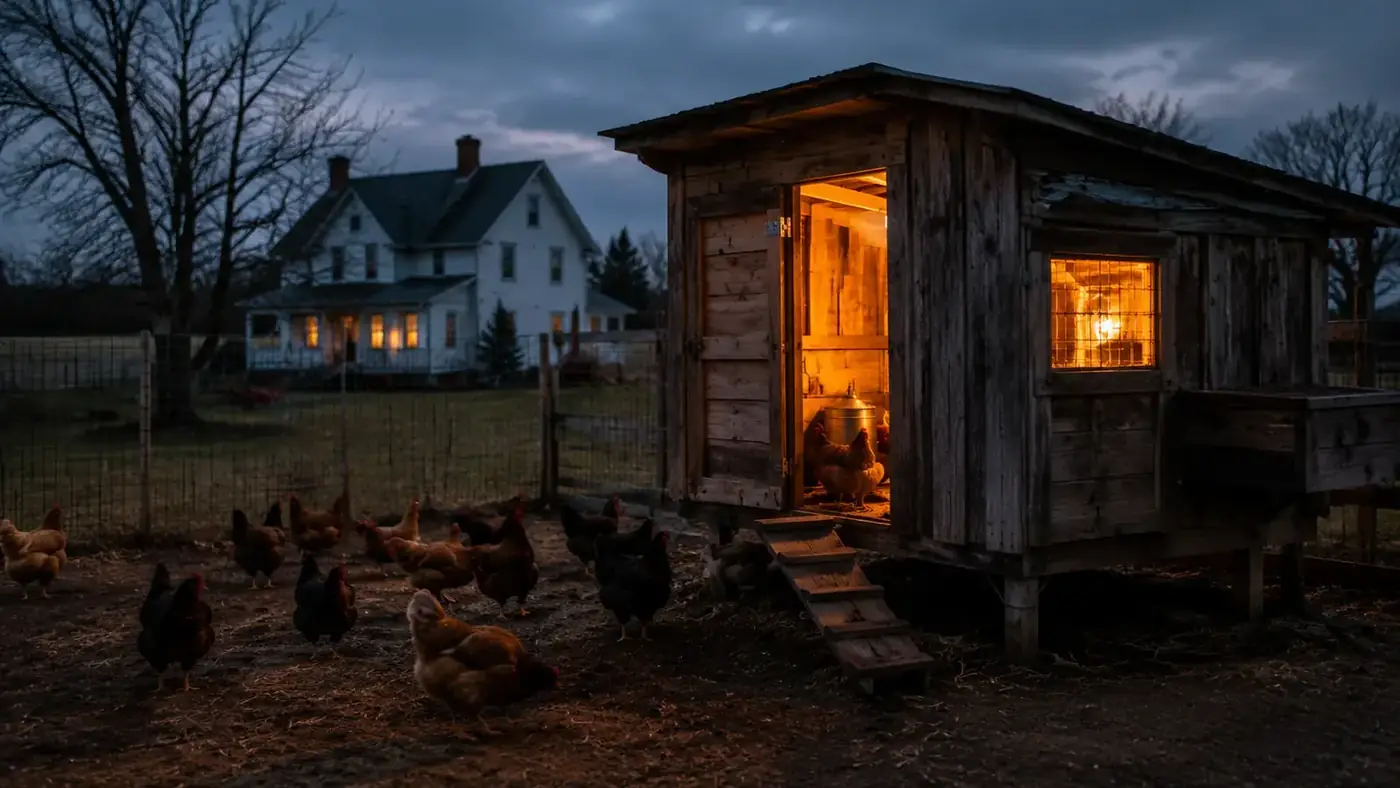
If you only fix one weak spot tonight, install a RUN-CHICKEN T50 automatic coop door, the rest of this guide stacks on top of that one decision. I lost two hens before I figured this out. The first was a Rhode Island Red named Dot. The second was a Buff Orpington I never got around to naming, which somehow made it worse. Both were gone by the time I got out to the coop in the morning, no feathers, no trace, just a door that had been pried open an inch and a coop full of terrified birds. That was three years ago. Since then, nothing has gotten in. Not a single bird lost to a predator. This guide is every change I made.
Most backyard coop setups have at least three or four entry points that a determined raccoon, fox, or weasel can exploit. The good news is that closing them is not complicated or expensive. It just takes working through the list in the right order. Start with the structure, then the hardware, then the latch, then the door. By the time you reach Step 5 you will have covered every realistic overnight threat.
If you only fix one thing tonight, make it the door that closes itself.
The RUN-CHICKEN T50 automatic coop door closes at dusk and locks at a time you set, whether you remember or not. It runs on 4 AA batteries for up to a year and has a built-in safety sensor so no hen gets caught. Over 3,100 chicken keepers on Amazon rate it 4.1 stars. Check today's price below.
Amazon Check Today's Price on Amazon →Step 1: Audit Every Gap in Your Run and Coop Walls
Get down on your knees and go around the entire perimeter at dusk, when the light is low and gaps show up. You are looking for anything wider than half an inch. A weasel can fit through a 1-inch gap. A young rat can squeeze through 3/4 of an inch. I use a quarter coin as my gauge: if the coin passes through, something alive probably can too.
Pay special attention to corners where framing meets siding, anywhere a vent screen is attached, and the gap between the coop floor and ground. Check where your pop door frame meets the coop wall. Raccoons and opossums probe these edges with their hands before they commit to an entry. If they find give, they work it.
Write down every gap you find. Do not fix anything yet. Finish the audit first so you can prioritize by size and location. Ground-level gaps get fixed before roof-level vents because ground predators are your biggest overnight threat. Hawks are more of a dawn problem and less likely after full dark, but they still need to be addressed on the run roof.
Step 2: Replace Chicken Wire with Hardware Cloth
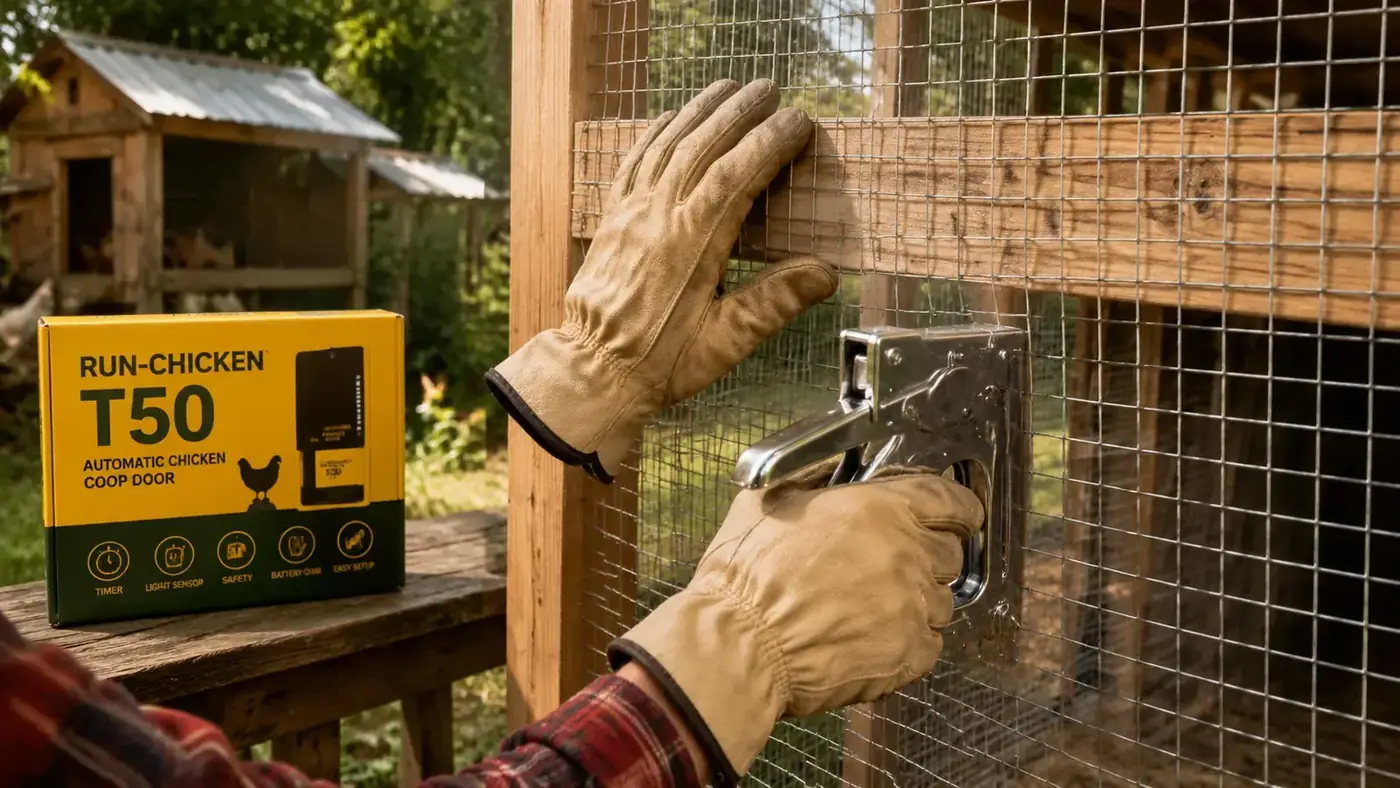
Chicken wire keeps chickens in. It does not keep predators out. I know that sounds backwards, but it is true. Chicken wire is made from thin twisted strands that a raccoon can pull apart with its hands in under two minutes. I have watched it happen. Hardware cloth, specifically 1/2-inch galvanized welded wire, is a completely different material. The welds are solid and the gauge is heavy enough that a raccoon cannot deform it by hand.
Replace any chicken wire on your run walls, especially the lower 24 inches, with 1/2-inch hardware cloth. Attach it with staples plus fender washers every 6 inches along all edges. The fender washers matter because a bare staple can be popped or pulled. For the run floor or apron, lay hardware cloth flat on the ground extending 12 inches outward from the base of the run. Cover it with a thin layer of soil or gravel. This stops digging predators, primarily foxes and dogs, from tunneling under the wall.
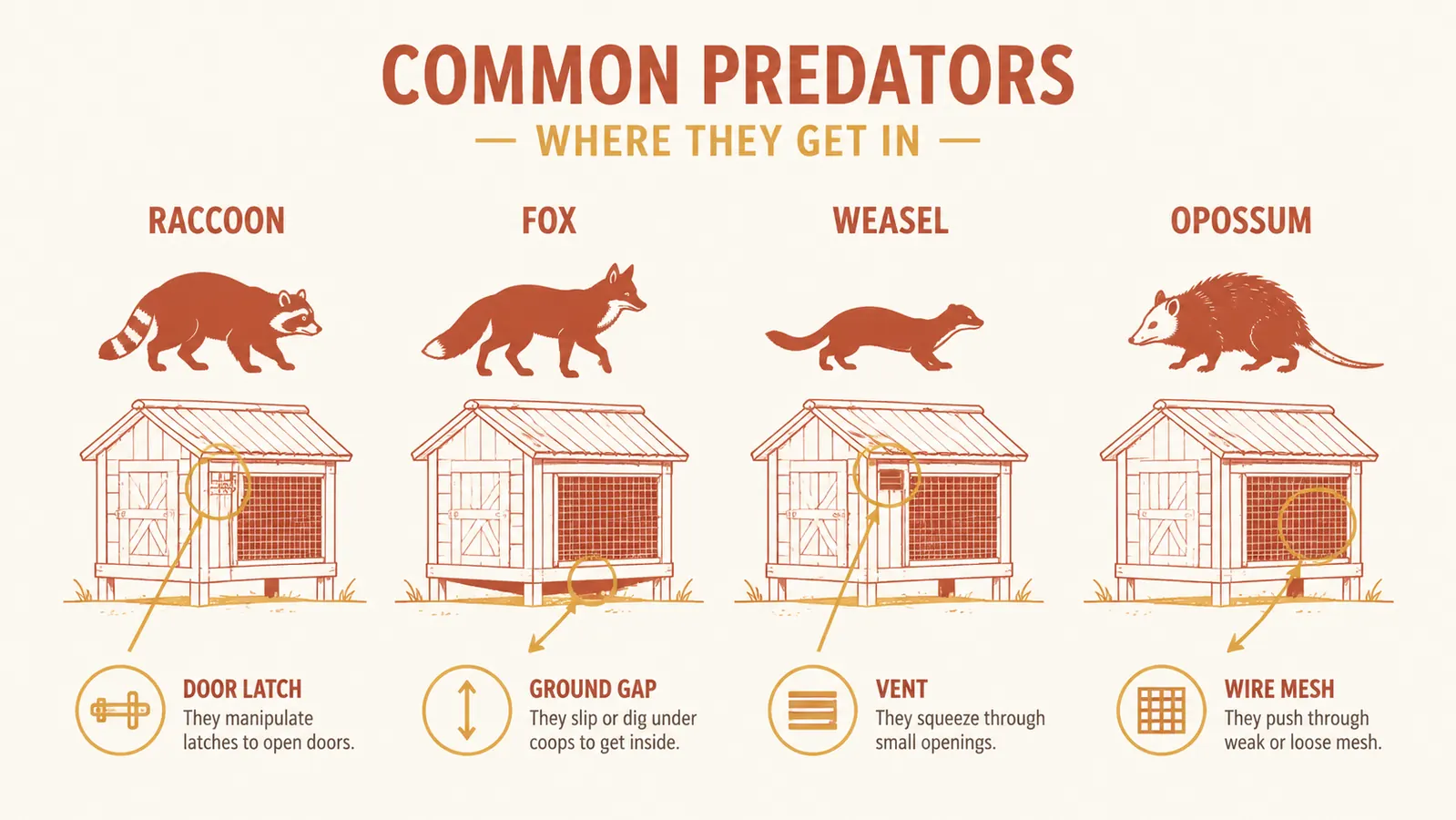
For vents, use the same 1/2-inch hardware cloth cut to size and screwed down with a solid frame, not just stapled to siding. Raccoons will pull at anything that flexes. A screwed-down frame does not flex.
Step 3: Upgrade Every Latch on the Property
Raccoons can open simple hook-and-eye latches. They have figured out sliding bolt latches too, especially the spring-loaded kind. The standard hardware store twist latch on most prefab coops can be opened in under ten seconds by a coon that has had one previous encounter with it. I am not exaggerating. There is video evidence of this all over the chicken-keeping forums.
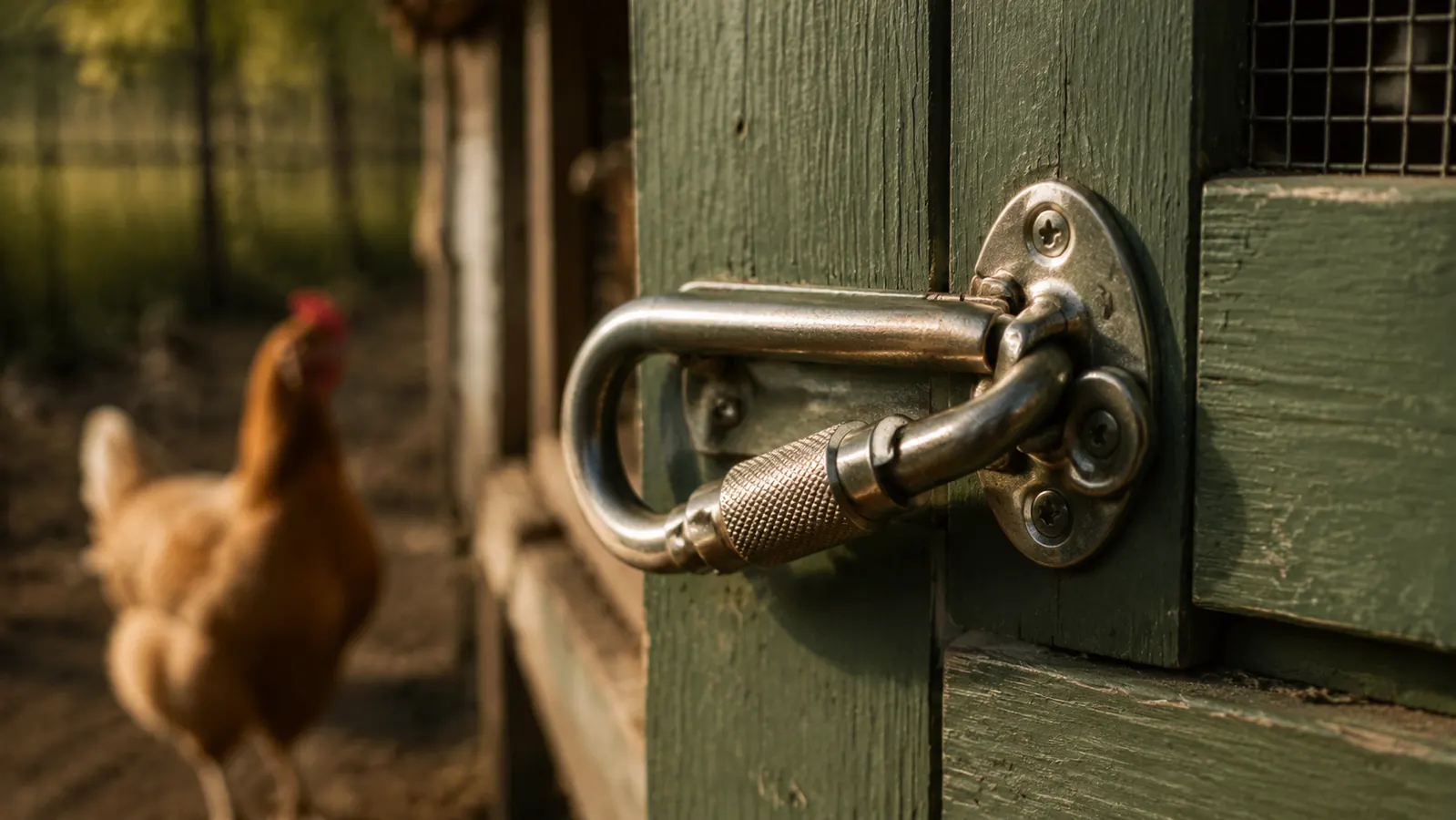
Replace every latch on your coop and run with a two-step mechanism that requires opposing hand movements to open. The most reliable options are carabiner-clip latches, which require you to squeeze and twist simultaneously, or barrel bolt latches paired with a separate padlock or secondary clip. Put one on every access point: the run door, the nesting box lid, the coop people-door, and especially the pop door if you are running a manual setup.
Opossums and foxes are not as dexterous as raccoons, but a fox can work a weak latch by pushing and nosing at a door repeatedly. Two-step latches stop them cold. Budget about $4 to $8 per latch and do not cut corners on this one. It is the cheapest upgrade with the most immediate return.
Raccoons can open a hook-and-eye latch. They have figured out sliding bolts. The fix costs $6 and five minutes per door, and it closes the single most common entry point overnight attackers use.
Step 4: Address the Ground Gap and Dig Guard
The ground gap is the space between the bottom of your run wall and the soil surface. Even a well-built run develops a gap over time as soil settles and boards warp. Foxes and dogs will dig straight down at the base of your run wall and come up inside. I had a neighbor lose four birds to a fox that dug in over the course of three nights, working the same corner a little deeper each time.
The apron method I described in Step 2 is the most reliable dig guard. If you cannot install a full apron, the next best option is an L-shaped hardware cloth skirt: run hardware cloth down the outside face of your run wall, then bend it outward 90 degrees at ground level for at least 12 inches. Pin it with landscape staples. The fox digs straight down, hits the horizontal mesh, cannot go forward, and eventually gives up. Rocks or pavers laid against the outside base of the run wall add another deterrent layer.
Step 5: Install an Automatic Coop Door
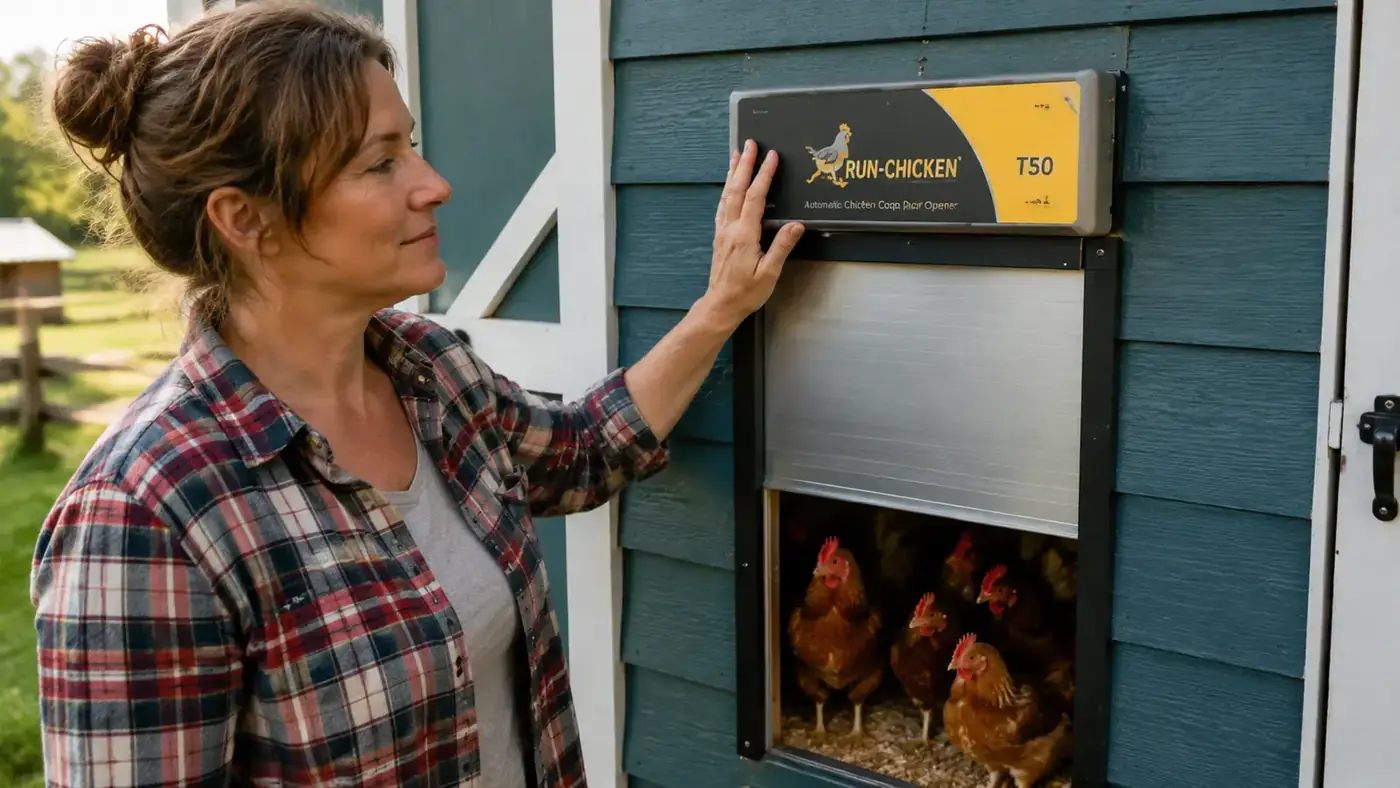
The pop door is the weakest point in the whole system, and the reason is simple: it depends on you. If you forget to close it, or close it late, or close it early and a hen is still outside, you have a problem. An automatic door removes the human variable entirely. It opens at first light and closes at dusk or at a time you program. The chickens go in when the sun goes down because that is what chickens do, and the door closes behind them whether you remember or not.
The RUN-CHICKEN T50 is the unit I have been running for over a year. It is battery-powered on 4 AA batteries that last up to 12 months, so there is no wiring or extension cord involved. The door uses a light sensor plus a programmable timer as a fallback, so it closes reliably even on overcast days when pure light-sensing units sometimes hesitate. The safety sensor on the bottom edge detects if a bird is in the way and stops the door from closing on her. Setup takes about 30 minutes with a drill and the included hardware.
One practical note: the T50 door is 10.6 inches wide by 15.7 inches tall. That covers most standard breeds comfortably, including large hens like my Buff Orpingtons and my one Jersey Giant. If you have a very large breed or a wide custom opening, measure before you order. The full review with notes on installation is at the link below.
Stop relying on yourself to close the coop every night.
The RUN-CHICKEN T50 automatic coop door closes at dusk on its own schedule, runs a year on 4 AA batteries, and has a built-in safety sensor that stops the door if a hen is in the way. Rated 4.1 stars by 3,141 chicken keepers. See my full long-term review and check today's price on Amazon.
Amazon Check Today's Price on Amazon →What Else Helps
Motion-activated lights are worth adding around the run perimeter. Raccoons and foxes are opportunistic and will usually back off when a floodlight fires. Position one on each approach side of the coop and set them to the shortest sensitivity range so house cats and blowing leaves do not trigger them every hour all night. They do not replace the structural fixes above, but they add a deterrent layer that occasionally turns a predator away before it even reaches the hardware.
Electric net fencing is an option for free-range flocks that use a large paddock at night. A single strand of electric fence at 8 and 16 inches off the ground around the outside of the run will deter foxes and dogs that approach the perimeter. It is more setup than most backyard keepers want to deal with, but if you have lost birds to a persistent fox that keeps coming back, a single fence charger is often the thing that finally breaks the pattern.
Dawn is also a real threat window that most keepers underestimate. Hawks are not a nighttime predator but they start hunting at first light, which is exactly when an automatic door opens. If you keep your run covered with bird netting or hardware cloth on top, your flock can go outside at dawn without exposure. An uncovered run with a door that opens at 5:30am in summer leaves your birds vulnerable to red-tailed hawks and Cooper's hawks for up to two hours before you are out there.
For the record, the predator lineup you are defending against most nights looks like this: raccoons (the most dexterous and persistent, active midnight to 4am), red foxes and gray foxes (diggers, faster than raccoons, active dusk through early morning), Virginia opossums (slower, mostly opportunistic, rarely the cause of mass losses but will take a bird if access is easy), and weasels or mink near waterways (can kill an entire flock in one night through very small gaps, so the hardware cloth work in Step 2 is particularly important if you are near a creek or pond). Hawks are daytime threats. Great horned owls will take birds at night if the run is open to the sky, but a covered run or solid roof eliminates them.
The auto-door is the last piece of a solid predator-proof setup.
You have done the hardware cloth, the latches, the dig guard. The final fix is a door that does not depend on you remembering. The RUN-CHICKEN T50 has been closing my coop every night for over a year. See the full long-term review or check today's price on Amazon below.
Amazon Check Today's Price on Amazon →