
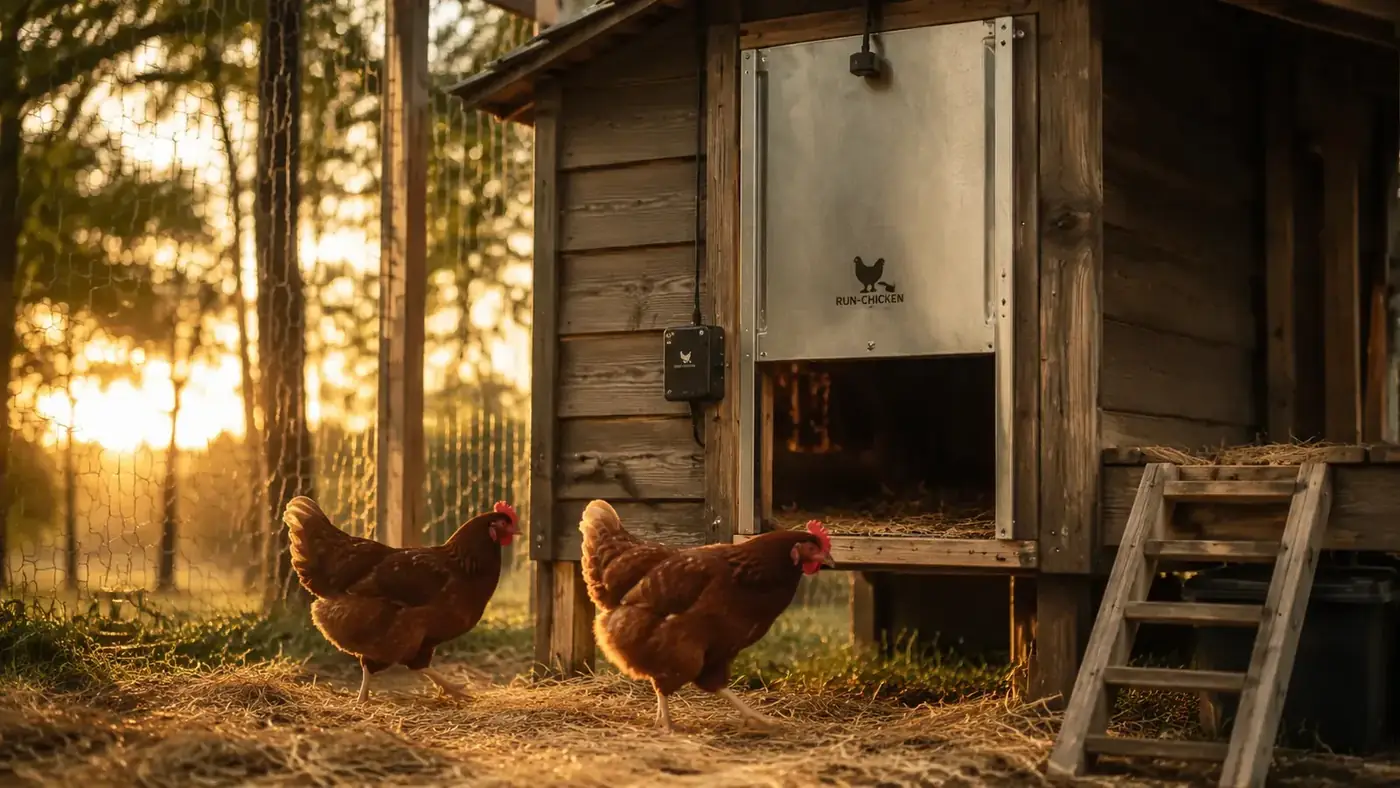
If you have lost a hen to a predator that came through while you were asleep, or while you were traveling, or just because you forgot one evening, you already know why automatic coop doors exist. The question is which one you can actually trust with your flock. Two names keep coming up for backyard keepers on a budget: the RUN-CHICKEN T50 and the VEVOR automatic door. They are priced within $30 of each other, both run on batteries, both claim to open at dawn and close at dusk. I have had the T50 on my coop for going on 18 months now. My neighbor ran the VEVOR for a season before switching. Here is the full breakdown.
Short answer: the RUN-CHICKEN T50 is the better door. The VEVOR is not broken or dangerous, but the T50 wins on build quality, sensor reliability in marginal light, and cold-weather battery performance. If you are in a climate with real winters, or you have a predator pressure problem, the gap between them matters more than the price difference.
| Feature | RUN-CHICKEN T50 | VEVOR Auto Door |
|---|---|---|
| Door material | Brushed aluminum, 0.08" thick | Painted sheet metal, thinner gauge |
| Motor type | Worm-drive DC motor | Direct-drive DC motor |
| Sensor | Dual light sensor (redundant) | Single light sensor |
| Timer mode | Yes, plus light-sensor mode | Light-sensor only on base model |
| Door size | 11.4" x 15" | 11.8" x 15.7" |
| Battery type | 4x AA alkaline or rechargeable | 4x AA alkaline |
| Rated battery life | Up to 1 year per set | Up to 6 months per set |
| Low-battery alert | LED warning light | None |
| Cold-weather rating | Tested to 4°F | No stated cold rating |
| Manual override | Yes, button on unit | Yes, button on unit |
| Warranty | 2 years | 1 year |
| Amazon rating | 4.1 stars (3,141 reviews) | 3.8 stars (approx. 900 reviews) |
| Current price | ~$130 | ~$100–110 |
Where the RUN-CHICKEN T50 Wins
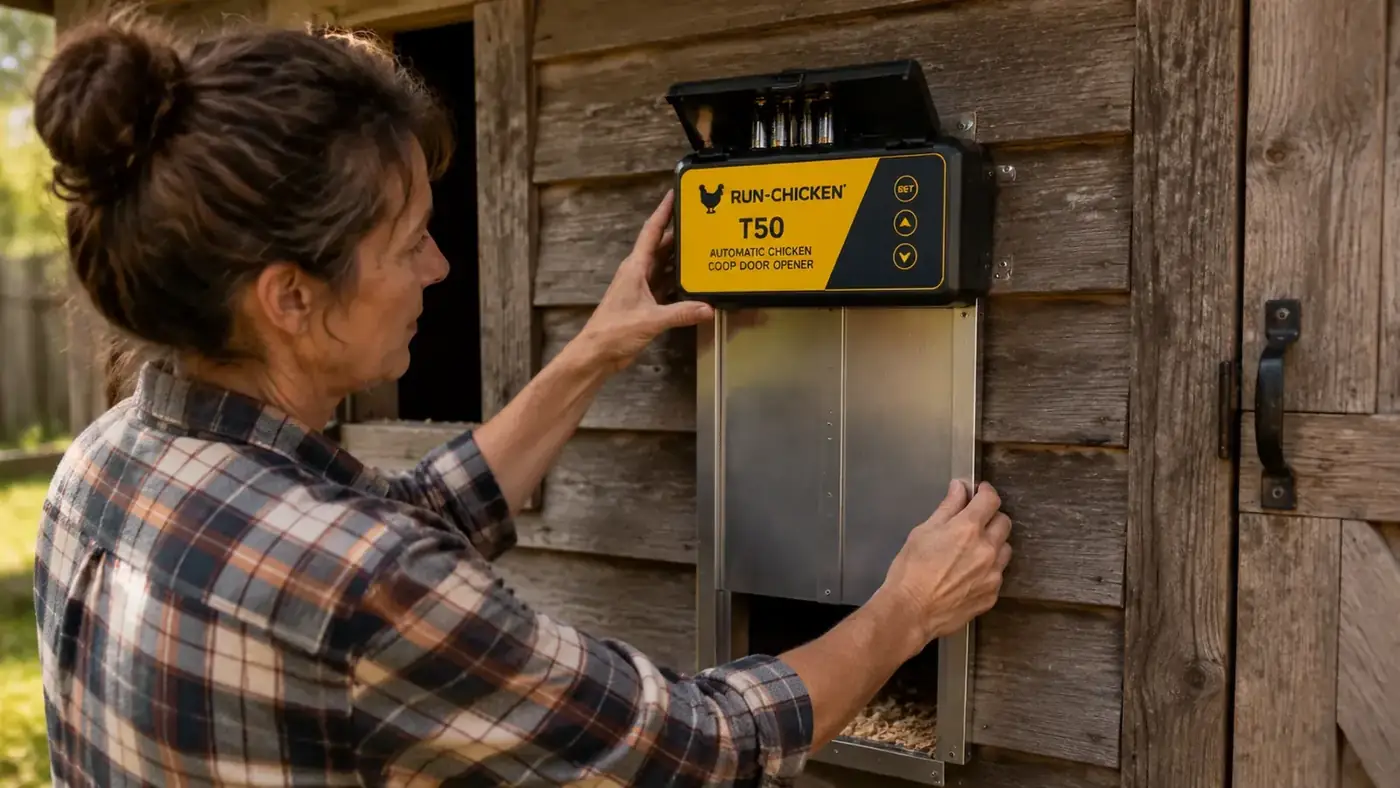
The first thing you notice with the T50 is the aluminum door panel itself. It does not flex when you press it. It does not dent if a Dominique hen decides to slam into it. My girls did exactly that for the first two weeks while they sorted out the new routine, and the door came through without a scratch. The VEVOR door is made from thinner painted sheet metal. My neighbor's VEVOR developed a slight bow along one edge by its third month, which meant it no longer seated perfectly flush at the bottom. A quarter-inch gap at the bottom of a coop door is an invitation for weasels, and weasels will absolutely accept that invitation.
The dual light sensor is the other meaningful difference. The T50 uses two light sensors positioned to average ambient light readings, which means it does not false-trigger when a car's headlights sweep across the yard or when a security light kicks on. My neighbor's VEVOR tripped open twice in the middle of the night during her first month, both times when a motion-sensing floodlight turned on. The T50 has never false-opened on me. For a flock of six Buff Orpingtons that I am not willing to lose to a fox, that matters.
Where the VEVOR Holds Its Own
The VEVOR is not a bad door. The door opening is slightly larger, which helps if you have big breeds. I keep Buff Orpingtons and Barred Rocks, both of which are not exactly petite, and they have zero trouble with the T50's 11.4-inch opening. But if you run Jersey Giants or a big Brahma rooster, the extra width of the VEVOR could be worth considering. The motor on the VEVOR is also reasonably quiet, and it handled normal summer and fall temperatures without issues.
The price gap is the VEVOR's clearest argument. At roughly $100 to $110 versus $130 for the T50, it is a $20 to $30 difference. If you are outfitting multiple coops on a tight budget, that adds up. And if you live somewhere with mild winters and no serious predator pressure, the VEVOR's weaknesses are less likely to bite you. It is a reasonable door for a reasonable situation.
Your coop deserves a door that closes every single night, no exceptions.
The RUN-CHICKEN T50 has 3,141 Amazon reviews and a 4.1-star rating. It is the door I trust with my flock 365 nights a year. Check today's price and availability below.
Amazon Check Today's Price on Amazon →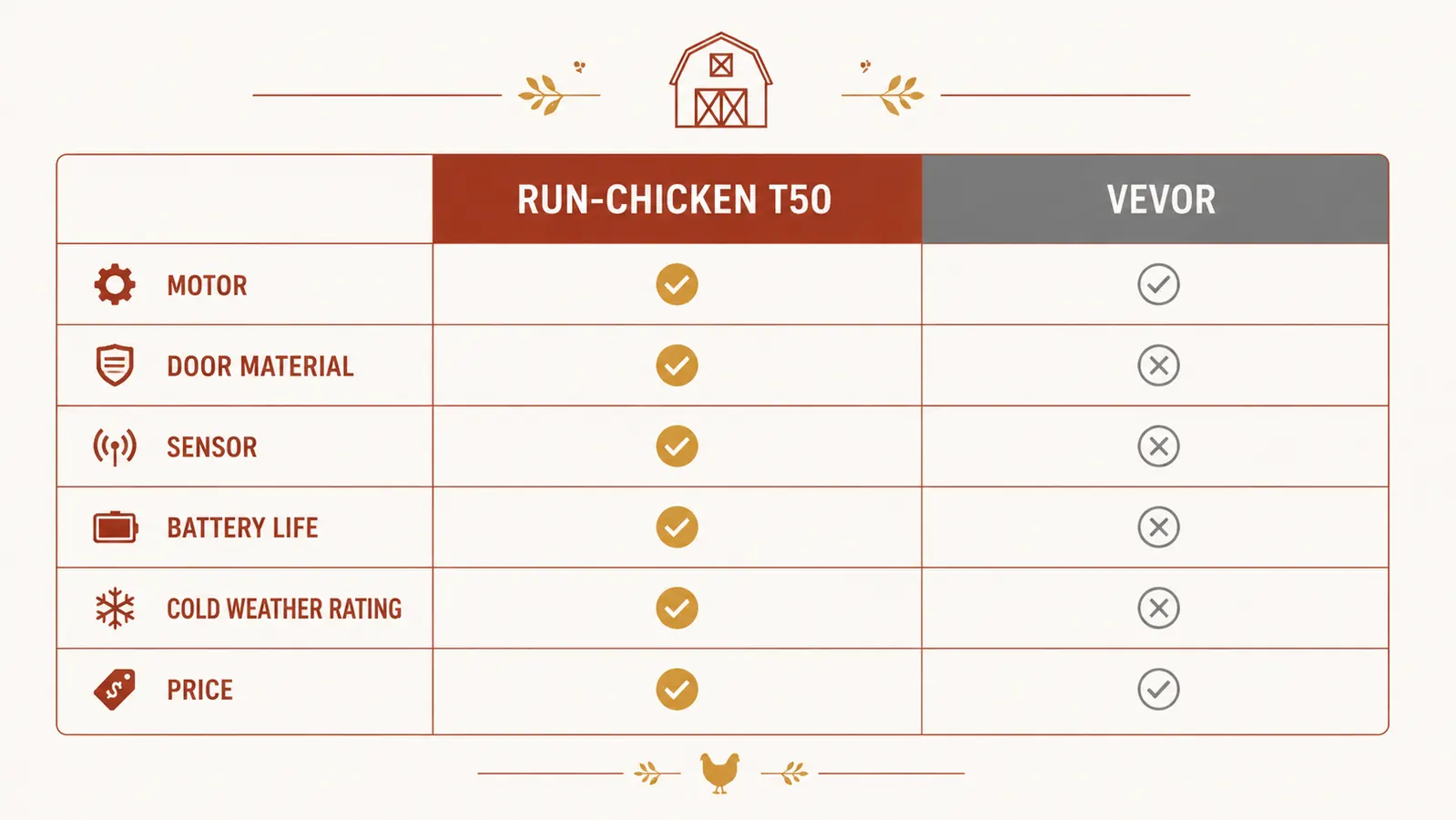
Battery Life in Real Winter Conditions
This is where the T50 really separates itself if you are anywhere north of zone 7. I am in central Ohio. We get weeks of nights in the single digits and a few runs below zero every winter. The T50's worm-drive motor draws less current per cycle than a direct-drive motor, and the unit itself is sealed better against moisture. My first set of Energizer AA batteries lasted 11 months, October through the following August, through two hard cold snaps. The T50 also has a small LED that blinks red when batteries are getting low, which is the kind of thing you do not think you need until a January night when you would have no other warning.
My neighbor replaced her VEVOR's batteries three times in one season. Part of that may have been the false-opens running the motor more than intended. But even discounting that, her VEVOR was chewing through batteries roughly twice as fast as my T50 in the same Ohio winter. The difference in battery chemistry tolerance between the two motors is real.
A quarter-inch gap at the bottom of a coop door is an invitation for weasels. And weasels will absolutely accept that invitation.
Installation and Setup
Both doors install the same basic way: you cut or frame an opening in your coop wall, attach the door track, slide in the door panel, wire up the sensor, and drop in batteries. The T50 instructions are clear and include a physical paper manual plus a QR code to a video walkthrough. I had it mounted and running in about 40 minutes with a drill and a jigsaw. The VEVOR instructions my neighbor used were translated from Chinese and left a few steps genuinely ambiguous. She figured it out, but it took longer and required a YouTube video to fill in the gaps.
One practical note on sizing: both doors require you to frame out a clean rectangular opening. If your coop has an existing flap-style door, you will need to remove it and patch the framing before installing either unit. Budget an extra hour if you are retrofitting rather than installing in a new coop.

Predator Seal and Close Pressure
I want to address something that comes up in almost every review thread for automatic coop doors: closing force. Raccoons will absolutely try to push up a door that is not fully seated. The T50's worm-drive motor holds the door under constant tension when closed. You physically cannot push it up from the outside without defeating the motor. I have tested this myself with a piece of scrap wood. The door does not budge. The VEVOR's direct-drive motor holds the door in position, but there is slightly more give when you apply upward pressure. It would likely stop a casual raccoon. Whether it would stop a persistent one that has been working a latch for an hour, I am less confident.
A raccoon got my neighbor's Australorp through a different entry point, not the door itself, so I cannot say her VEVOR definitely failed there. But I will tell you I sleep differently knowing the T50's motor is holding that door closed.
Who Should Buy the RUN-CHICKEN T50
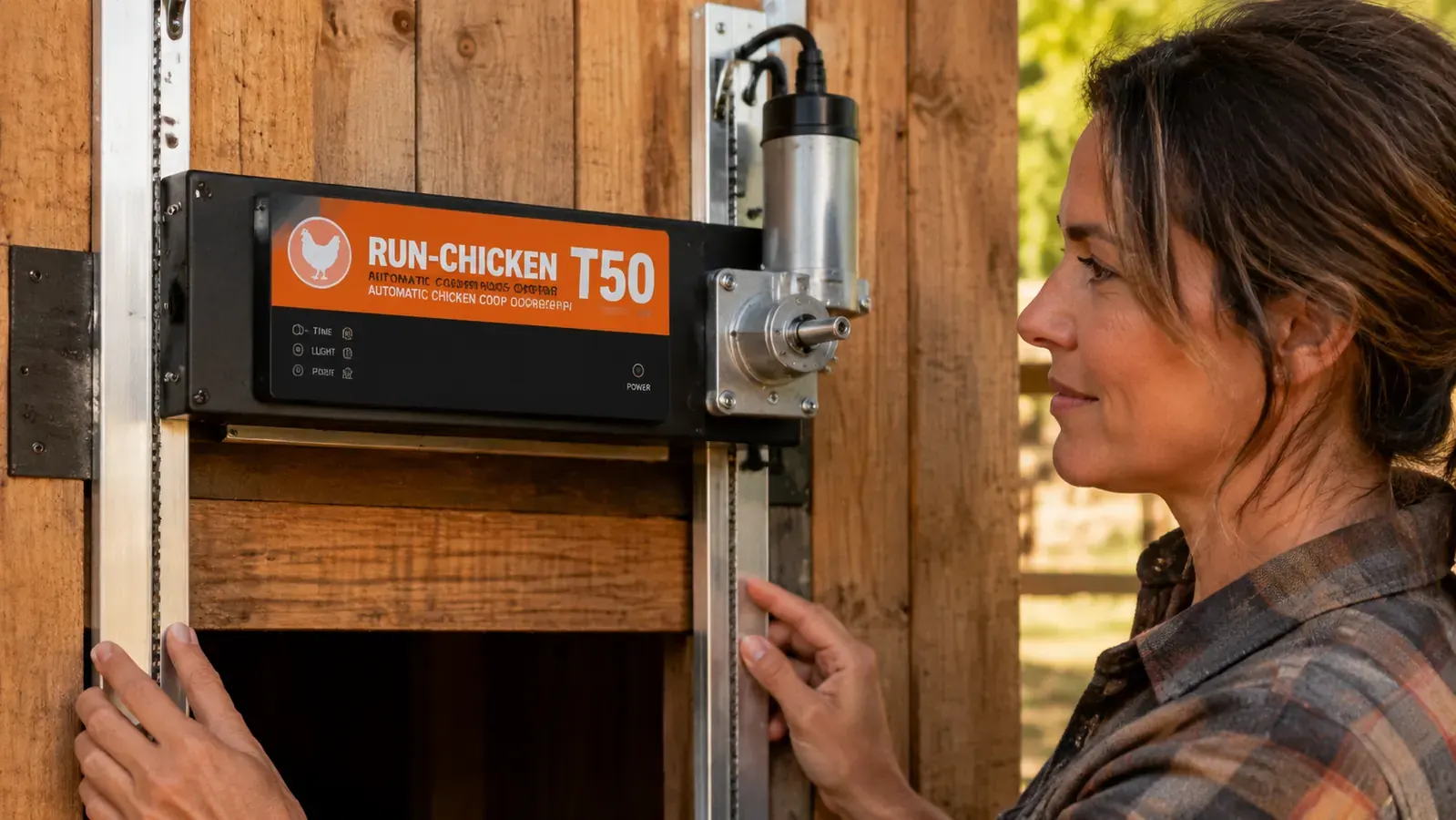
Buy the T50 if: you are in a cold climate, you have raccoons or weasels in your area, you keep a breed you care about deeply, or you simply want to set it up and not think about it again for a year or more. It is the right tool for anyone who cannot check on the coop every night, anyone who travels, and anyone who has already lost a bird and does not want to lose another. The 2-year warranty and the LED low-battery indicator are small features that compound into real peace of mind.
Who Should Look at the VEVOR
The VEVOR makes sense if you keep very large breeds who might crowd the T50's 11.4-inch opening, if you are in a mild climate where cold-weather battery performance is not a factor, or if you need to outfit two or three coops and the combined price difference is meaningful. It is also fine as a short-term solution while you decide whether automatic doors are worth the investment for your setup. It will do the job most nights. It just will not do it as reliably or as durably as the T50 over the long run.
The T50 has been on my coop for 18 months. It has never missed a close.
Three thousand chicken keepers on Amazon agree it is worth the price. If you are ready to stop worrying about what happens at dusk when you are not home, here is where to get it.
Amazon Check Today's Price on Amazon →