
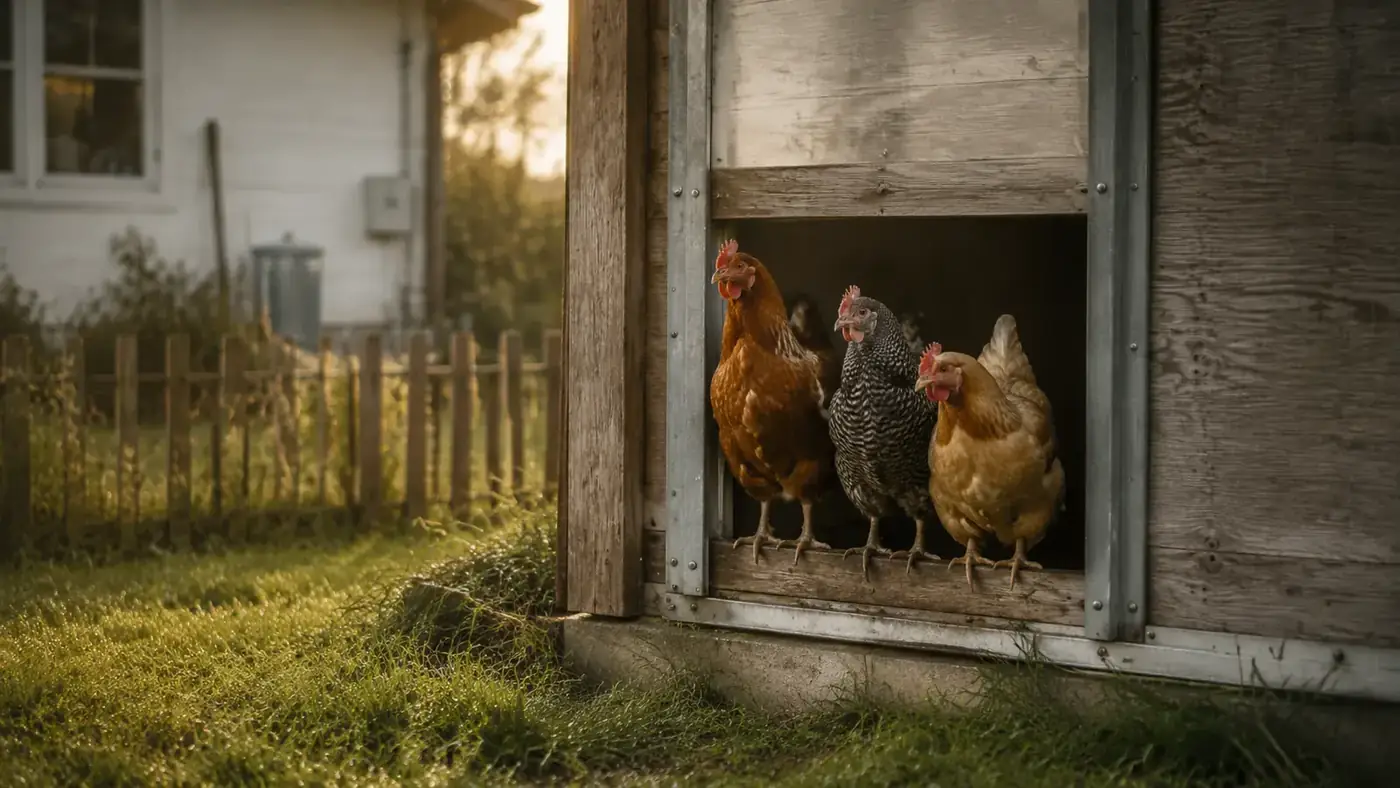
I want to be upfront with you: this is not the review where everything works perfectly and I end with a tidy five stars. I have used the RUN-CHICKEN T50 on my coop for months, and I like it well enough to still have it mounted out there right now. But I have also stood in my backyard in my pajamas at 10 p.m. because the door did not close when it was supposed to, and I feel like you deserve to know about that before you hand over your money.
What I am going to cover here are the things keepers typically find out after they buy: how the light sensor actually decides when dawn is, what cold weather does to the battery cycle, how the door behaves when snow packs around the base, how the latch holds up over time, and who should probably choose a different option entirely. If you want the straight installation walkthrough and the long-term wear story, I have a separate review for that over at the long-term use review. This one is about the quirks.
The Quick Verdict
A genuinely useful automatic door with real-world quirks around sensor timing and cold-weather battery performance that the listing undersells. Right for most small flocks, wrong for extreme climates or anyone who needs precise open/close times.
Amazon Check Today's Price →Tired of setting a 5am alarm to let the hens out? The T50 handles it, mostly.
Before you read the full breakdown below, here is a quick link to check the current price and availability. I will tell you exactly who should and should not buy this, but the T50 is still one of the better light-sensor doors at this price point.
Amazon Check Today's Price on Amazon →How the Light Sensor Actually Decides When to Open
The T50 opens and closes based on a light sensor, not a clock. The listing presents this as a feature, and in many ways it is. The door tracks actual sunrise and sunset instead of you having to reprogram it every few weeks as the days get longer or shorter. But there is a catch that the product description glosses right over: the sensor does not react instantly. It averages ambient light over a short window before deciding to act.
In practice this means the door opens roughly 15 to 30 minutes after first light, not at the moment the sky brightens. On a clear summer morning in late June, first light around my coop hits at 5:15 a.m. but the door does not slide open until closer to 5:40. My girls are piled against the door by 5:20, loudly expressing their opinions. It is not a safety problem. It is an annoyance, and it is the kind of thing that does not show up in the product photos.
The closing side has the same lag. On cloudy evenings the sensor can get confused. It reads a dark overcast sky at 4:30 p.m. in November the same way it reads dusk, so you can end up with a door that tries to close while hens are still out foraging. I have had to prop it back open twice during stormy afternoons. If your coop run is fully enclosed and predator-safe, a false early-close is just an inconvenience. If your birds free-range, you will want to keep an eye on the sky on heavily overcast days.
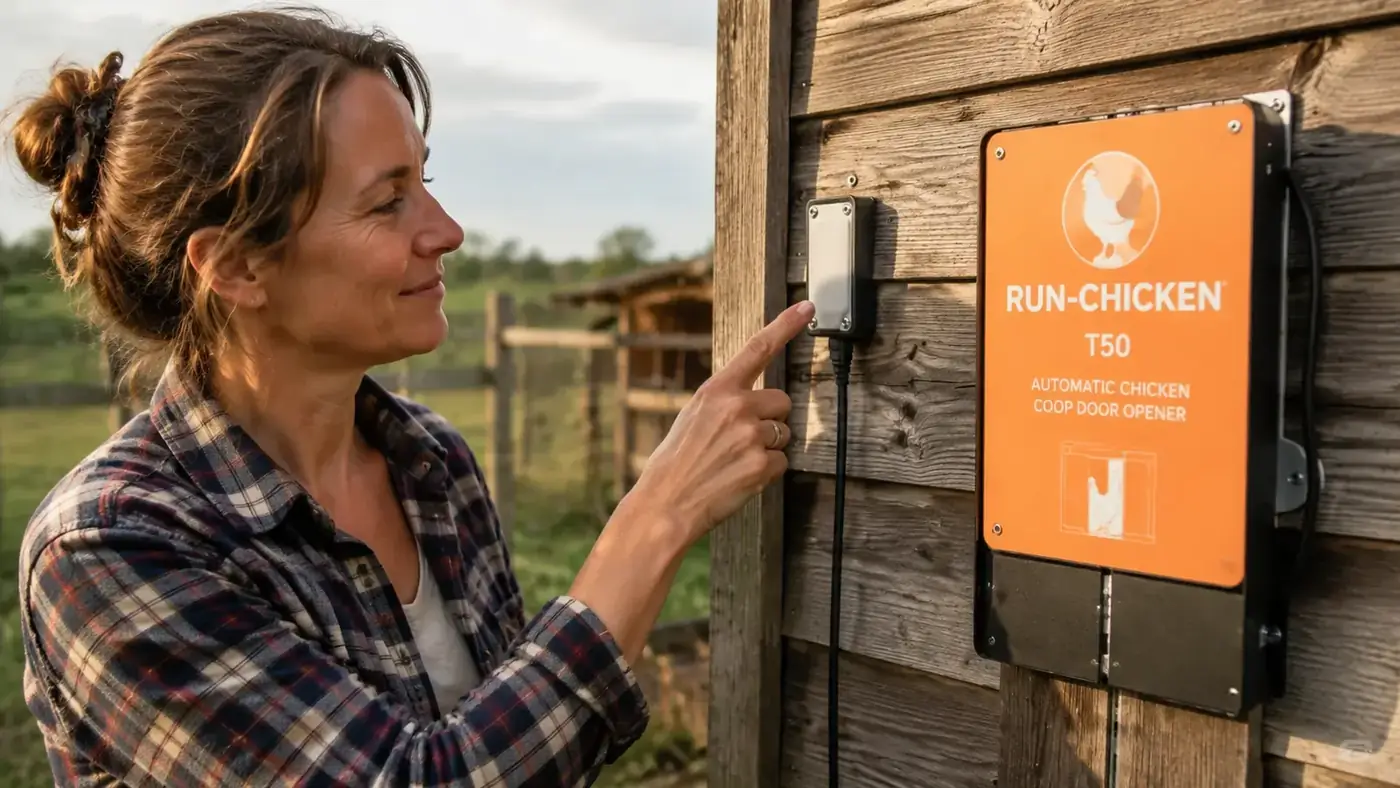
The sensor does not react to a single bright moment. It averages light over a window. That 15-minute lag is real, and your hens will remind you every morning.
What Actually Happens to the Battery in Cold Weather
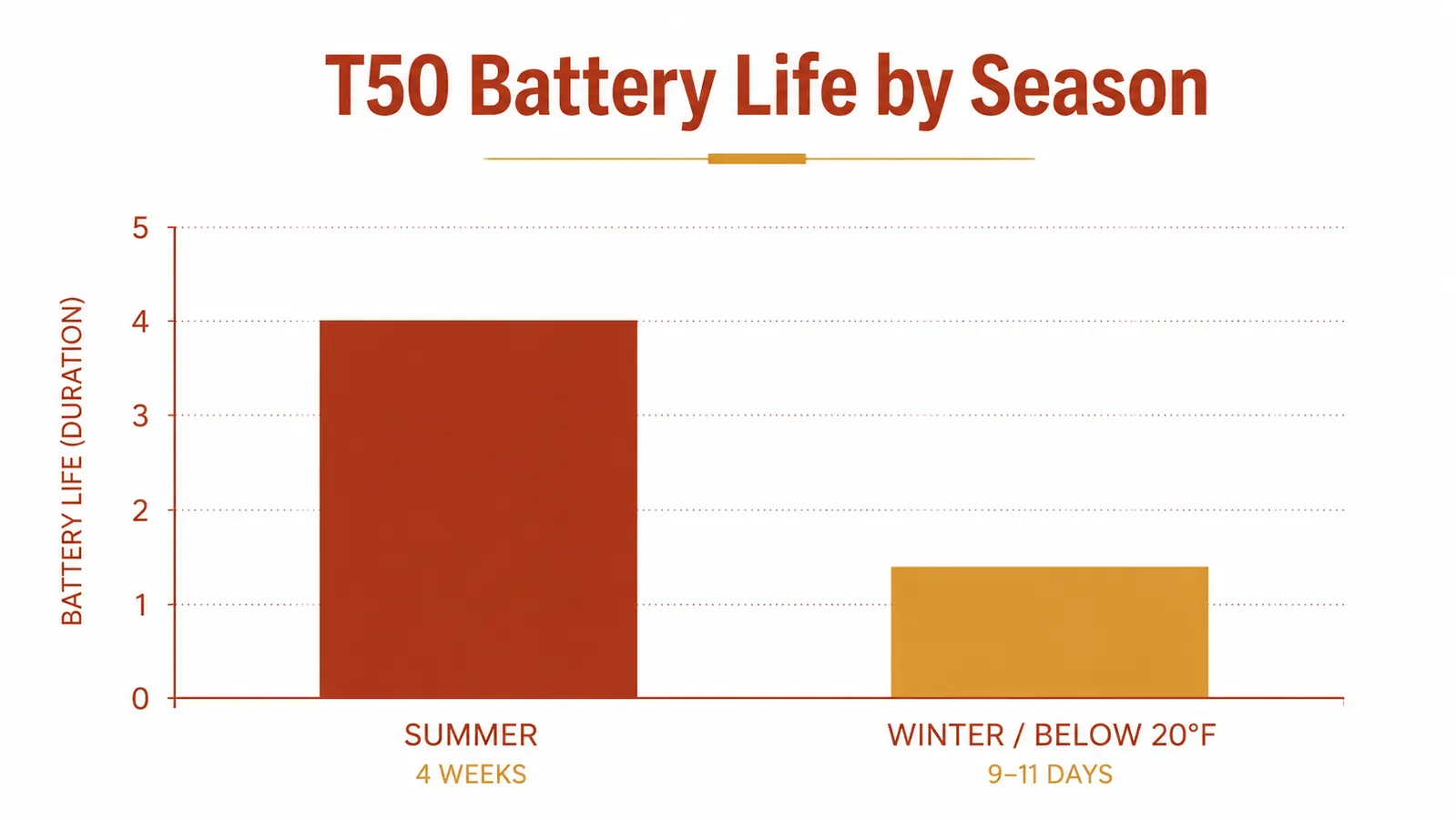
The battery compartment takes 4 AA batteries. In warm weather I get about four weeks between changes, which matches what the product page says. In January, when we had a stretch of nights at 8 to 12 degrees Fahrenheit, I was swapping batteries every nine to eleven days. That is not a T50 defect, that is just how alkaline AA cells behave in the cold: internal resistance climbs and effective capacity drops sharply below 20 degrees. But the listing says nothing about this, and nothing in the box warns you either.
Two things help. First, switching to lithium AAs instead of alkaline gives significantly better cold-weather performance. I ran Energizer Ultimate Lithium cells through our worst stretch this past winter and got closer to three weeks instead of nine days. The cost difference is real, but so is the peace of mind. Second, if you have a T50 with the optional solar panel add-on, understand that solar in winter is also marginal. A panel that keeps up fine in October in the Pacific Northwest may not generate enough charge on a gray January week in Ohio. The solar panel does not eliminate the battery-dependent nature of this door.
I do not want to overstate this. A dead battery does not mean the door springs open and leaves your flock exposed all night. The T50 is designed to fail-closed, meaning if the battery dies mid-cycle the door stays in whatever position it last occupied. If it dies at night with the door closed, your birds are safe. If it dies at noon with the door open, it stays open. Either way you will notice before anything bad happens, but you should check battery levels before any stretch of deep cold.
Snow, Ice, and the Bottom Track Problem
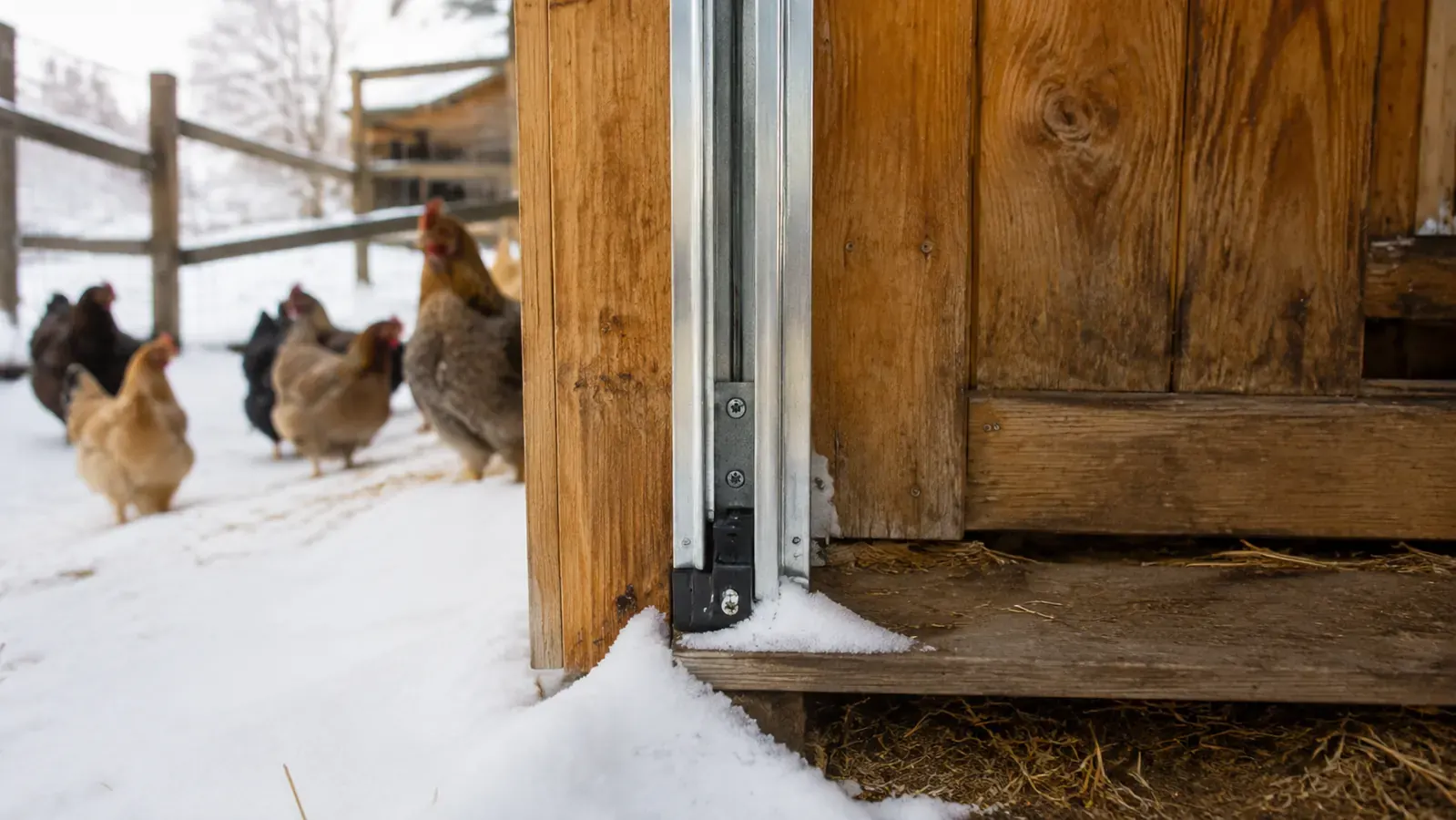
The door is a vertical slider. It runs in a plastic track, and the bottom of that track sits close to the ground. In any climate that gets meaningful snowfall, this becomes relevant. When I got three inches of overnight snow, a small drift packed against the bottom of the coop exterior, and by morning there was enough snow wedged in the lower track to stop the door from closing all the way. It closed to about a two-inch gap, which is absolutely enough space for a weasel to work through.
The fix is simple: I screwed a small piece of trim board along the base of the coop exterior to deflect snow away from the track opening. A lot of keepers in northern states put rubber weatherstripping around the track entry or mount the unit an inch higher than recommended so the base clears light snowfall. None of this is in the instruction sheet. You find it in forums after your first bad experience. Worth knowing before winter hits, not after.
Ice can cause a related problem. If rain falls late in the day and freezes overnight, it can ice the door into its frame. The motor will try to open it in the morning, and it will stall. The T50 has a stall detection feature that stops the motor from burning out, but the door will sit stuck until you go out and break it loose by hand. In my climate, this happens maybe twice a winter, which I can live with. If you are in a climate where freeze-thaw cycles happen every week, it might happen enough to be genuinely frustrating.
Latch Wear Over Time: The Thing the Listing Never Mentions
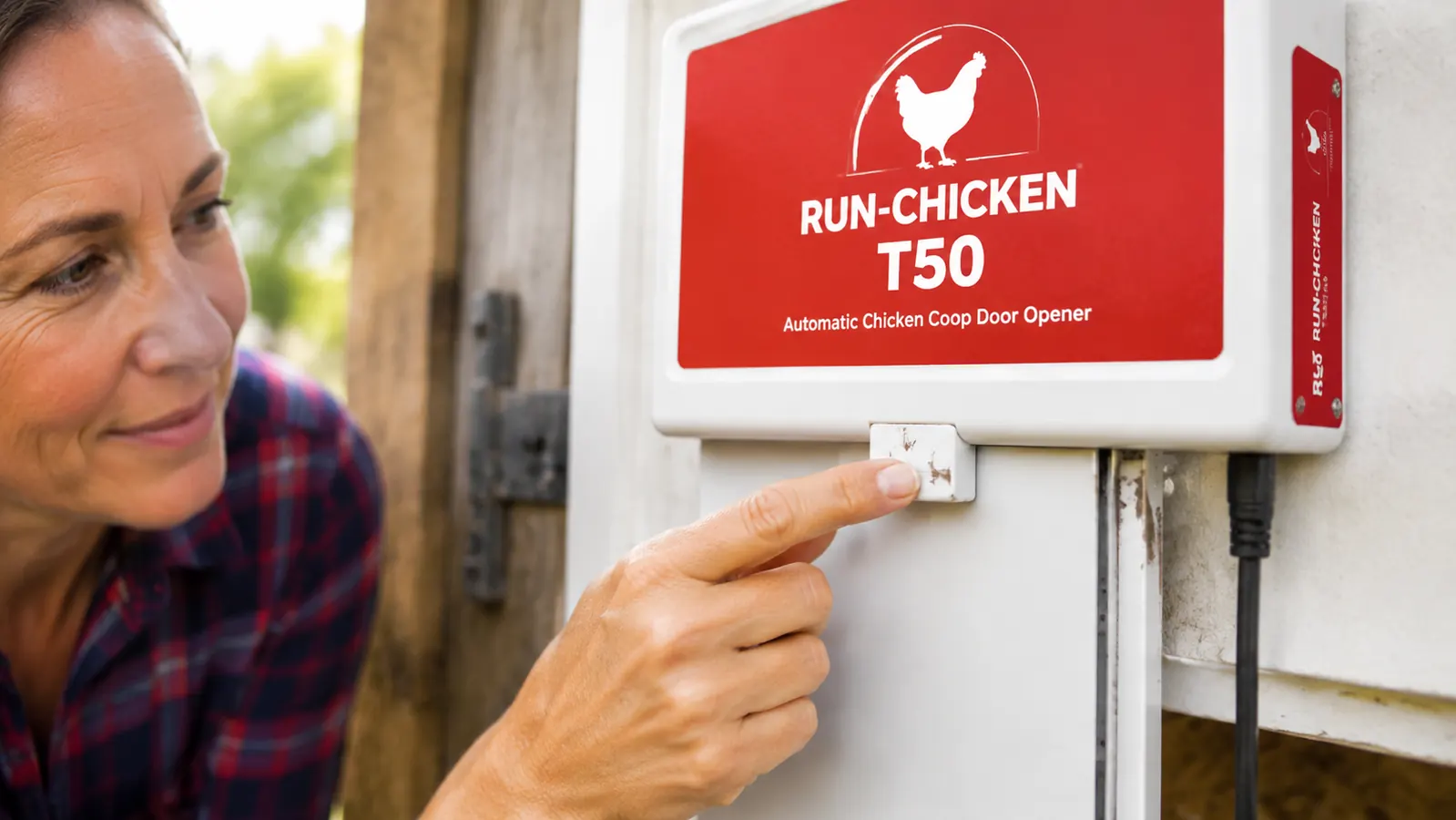
The door panel is aluminum and the latch mechanism involves a small plastic tab that seats into a notch when the door is fully closed. After about six months of daily cycling, the plastic tab on my unit developed noticeable play. The door still closes and latches, but I can wiggle it slightly, and when the wind picks up and shakes the coop, it rattles. I asked around on a couple of chicken keeping forums and found this is a pretty common experience around the six-to-twelve month mark.
RUN-CHICKEN does have customer service and does send replacement parts, which is one thing I genuinely respect about this company compared to some of the no-name auto door sellers on Amazon. I emailed them about the latch, described the issue, and had a replacement tab in the mail within a few days. The process was not difficult. But it is worth knowing that this is a consumable part, not a set-it-and-forget-it mechanism. If your coop is particularly drafty or exposed to wind, expect to deal with latch wear sooner rather than later.
What the Amazon Listing Does Not Say
Beyond the sensor lag and battery issues, a few things stand out as notable omissions from the product page. The T50 has no app, no connectivity, and no manual timer option. There is no way to set a hard open time of 7:00 a.m. or a hard close time of 8:30 p.m. The door operates entirely on the sensor and a sensitivity dial. If you want precise clock-based scheduling, this is not your product. The listing photographs do not show this limitation clearly, and plenty of buyers discover it after the fact.
The door opening width is also smaller than it looks in photos. The door panel is 11 inches wide, which works fine for standard-size hens like Barred Rocks, Buff Orpingtons, and Easter Eggers. But if you keep large Brahmas or Jersey Giants, or if you have an unusually heavy meat breed, they will squeeze through but it is tight. My biggest hen, a Buff Orpington I call Dumplin who weighs about nine and a half pounds, fits fine with a little shuffling, but a buddy of mine with dual-purpose Buckeye roosters in the twelve-pound range says his boys started ducking and shoving after their first year. Something to check against your flock before ordering.
The other thing the listing does not communicate clearly is that the sensitivity dial is trial and error, not a defined scale. There are no labeled positions, just a rotary dial with no markings. Getting it dialed in for your specific coop placement takes a few days of watching and adjusting, which is fine, but it surprises people who expect to unbox it and have it work perfectly on day one.
What I Liked
- Genuinely reduces predator risk when the battery is fresh and the weather cooperates
- Fail-closed design means a dead battery does not leave the coop wide open
- Company customer service is responsive and actually sends replacement parts
- Light-sensor auto-adjusts for seasonal day length without you touching anything
- Motor stall detection protects the mechanism when the door gets blocked
- Aluminum door panel holds up to pecking, wind, and moisture better than plastic alternatives
- 3,141 reviews give you a large real-world sample for troubleshooting
Where It Falls Short
- 15 to 30 minute light-sensor lag means the door does not open at actual dawn
- Battery life drops sharply below 20 degrees Fahrenheit, sometimes to under 10 days
- Snow can pack in the lower track and prevent full door closure
- Latch tab shows wear around the six-month mark and needs replacement
- No timer option, no app, no manual override beyond the physical dial
- Door width (11 inches) is tight for large or heavy breeds
- Sensitivity dial has no marked positions, calibration is purely by feel
Who This Is For
The T50 is a solid fit if you have a small to medium backyard flock of standard-size hens and you live somewhere with mild winters or you are willing to use lithium batteries and add a snow deflector to the base. It is also a good fit if you travel occasionally and want something that handles the door automatically without requiring someone to remember to go out at dusk. The company stands behind it, the fail-safe design is smart, and the price for what you get is reasonable. Most people who buy it are glad they did.
Who Should Skip It
If you keep large or heavy breeds like Jersey Giants, Brahmas, or heavy dual-purpose roosters, measure the 11-inch door width against your birds before buying. If you are in a climate with heavy snowfall and regular freeze-thaw cycles, budget for the extra maintenance or look at a door with a raised track mounting. If you want clock-based scheduling because your flock's routine does not match ambient light (maybe you keep them in an enclosed run and want to control timing tightly), you need a timer-based door, not this one. And if you are expecting a plug-and-play experience with zero calibration or upkeep, the T50 will disappoint you. It rewards a little attention. It does not run completely on autopilot forever.
For the side-by-side comparison against the VEVOR auto door, including how they differ on battery design and track system, take a look at my RUN-CHICKEN T50 vs VEVOR comparison. The differences matter more than most keepers realize before they buy.
If a light-sensor door works for your setup, the T50 is still one of the better ones at this price.
I have had mine out there through summer heat, winter cold, and a few snow events. It has quirks, but it does the core job and the company will help you when parts wear out. Check current pricing on Amazon and read through the Q&A section, which has a lot of real-world install questions answered.
Amazon Check Today's Price on Amazon →