
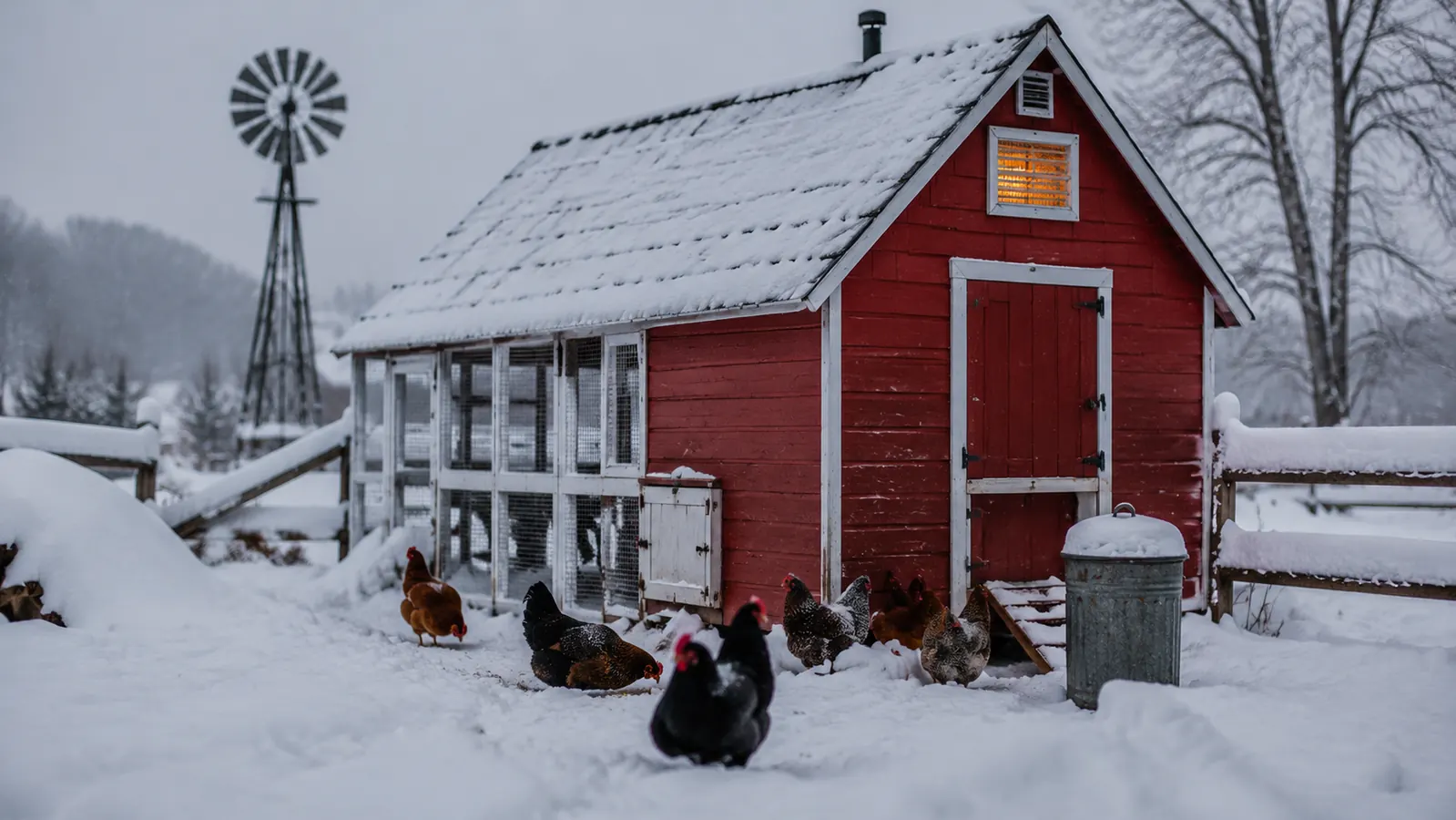
If you keep chickens in a cold climate, you already know the routine. You trudge out to the coop in the dark at 6am, coffee in hand, and discover a solid block of ice sitting where the waterer used to be. Your hens are standing around it looking at you like it is your fault. It might be. Because the waterer you chose matters more than most people realize, and not all heated waterers behave the same way when the temperature drops past the single digits and stays there for a week.
I have been keeping chickens in central Minnesota for eight years. I run a mixed flock of 11 hens in a well-insulated 8x10 coop, and I have a graveyard of equipment that did not survive the winters here. Two heated waterers are in that graveyard. After testing both the Farm Innovators 3-Gallon Heated Waterer and the API heated base setup over multiple winters, I can tell you clearly which one I trust and which one I quietly stopped recommending to my neighbors. Short answer: the Farm Innovators wins, and it is not particularly close once the temperature drops below 10 degrees.
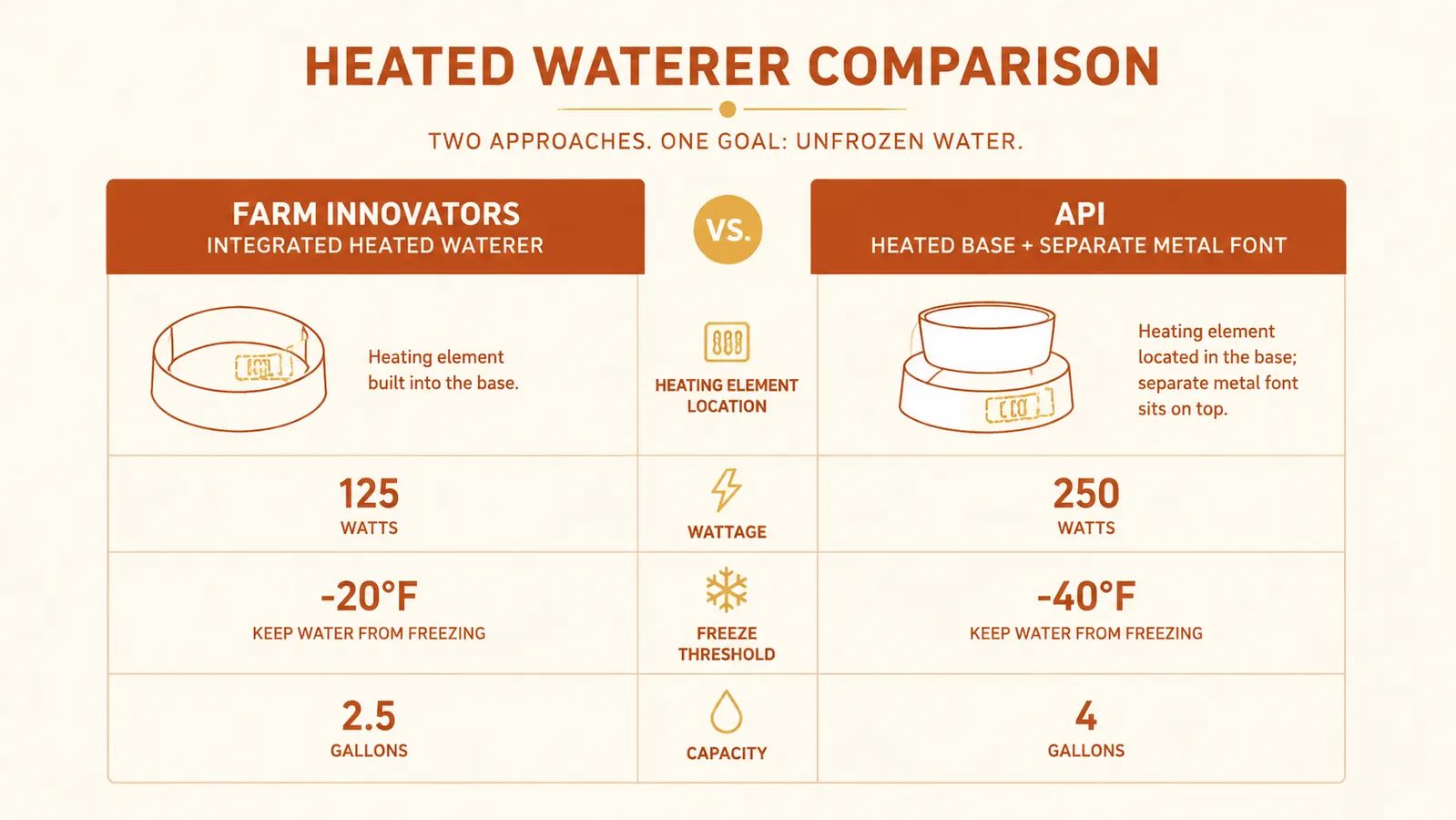
| Feature | Farm Innovators 3-Gal Heated Waterer | API Heated Poultry Base |
|---|---|---|
| Heating approach | Integrated thermostat, element built into base of waterer | Separate heated platform; waterer sits on top |
| Thermostat activates at | 35 degrees F | Varies by brand (most 35-40 F) |
| Wattage | 100 watts | Typically 150-250 watts (base only) |
| Effective low temp | Tested to roughly -10 F in normal coop conditions | Struggles reliably below 20 F in most reports |
| Capacity | 3 gallons | Depends on the metal fountain used (usually 3-8 gal) |
| Setup complexity | Hang directly, plug in, done | Requires matching base to compatible metal font |
| Compatibility risk | None (self-contained unit) | Base and font must be same brand or fit-tested |
| Cord length | 6 feet | Varies 5-6 feet |
| Total cost | Single purchase at current Amazon price | Base alone $30-50 plus $20-40 for a compatible font |
| Available on Amazon | Yes, single ASIN | Base and font often sold separately |
Where Farm Innovators Wins
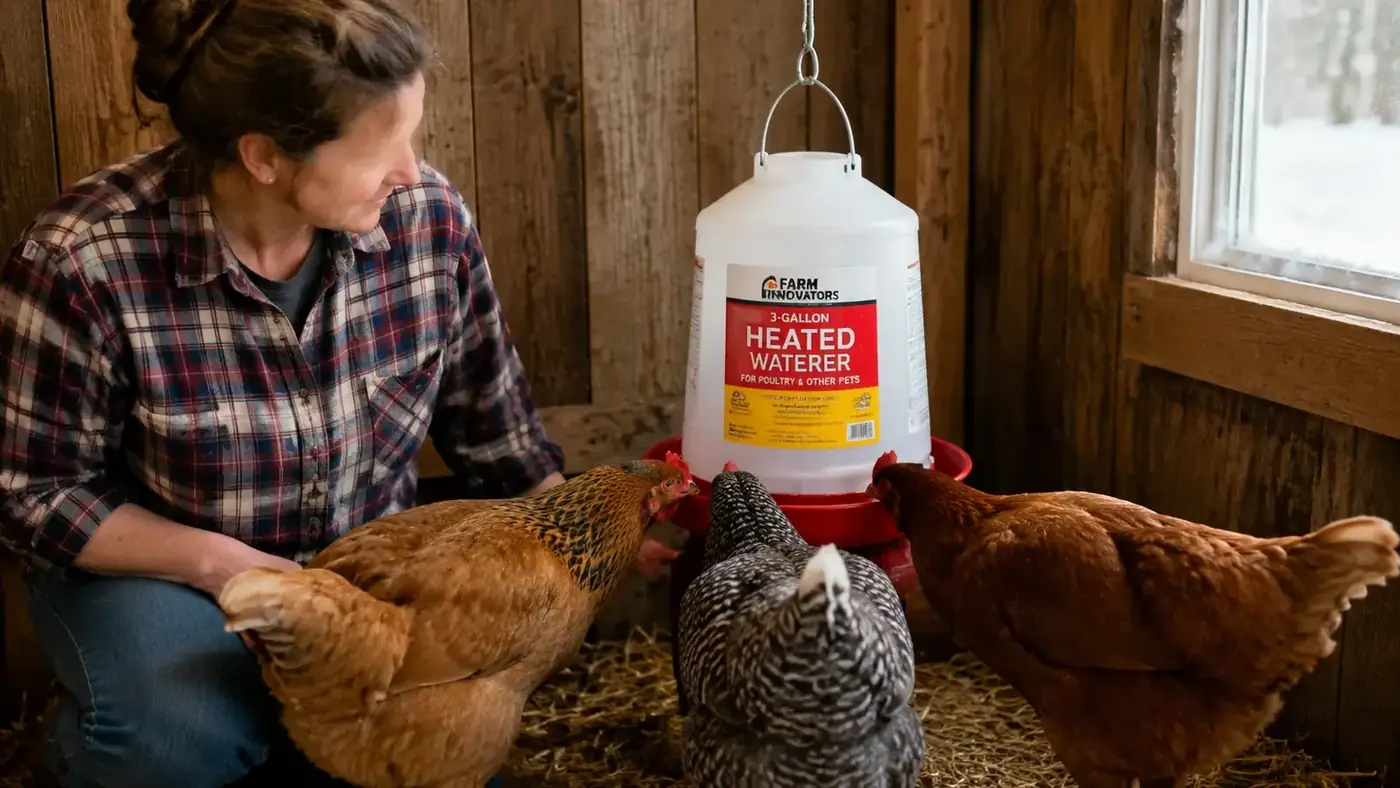
The biggest advantage the Farm Innovators has is that it is a single, self-contained system. There is no guessing about whether your heated base is making good thermal contact with the bottom of your waterer. The heating element is built directly into the unit. The thermostat is calibrated specifically for that waterer's thermal mass, meaning when it says it activates at 35 degrees, it means for that specific container with that specific water volume. You plug it in, hang it at the right height, and walk away. That simplicity is not a marketing pitch. It is the feature that matters most at minus 10.
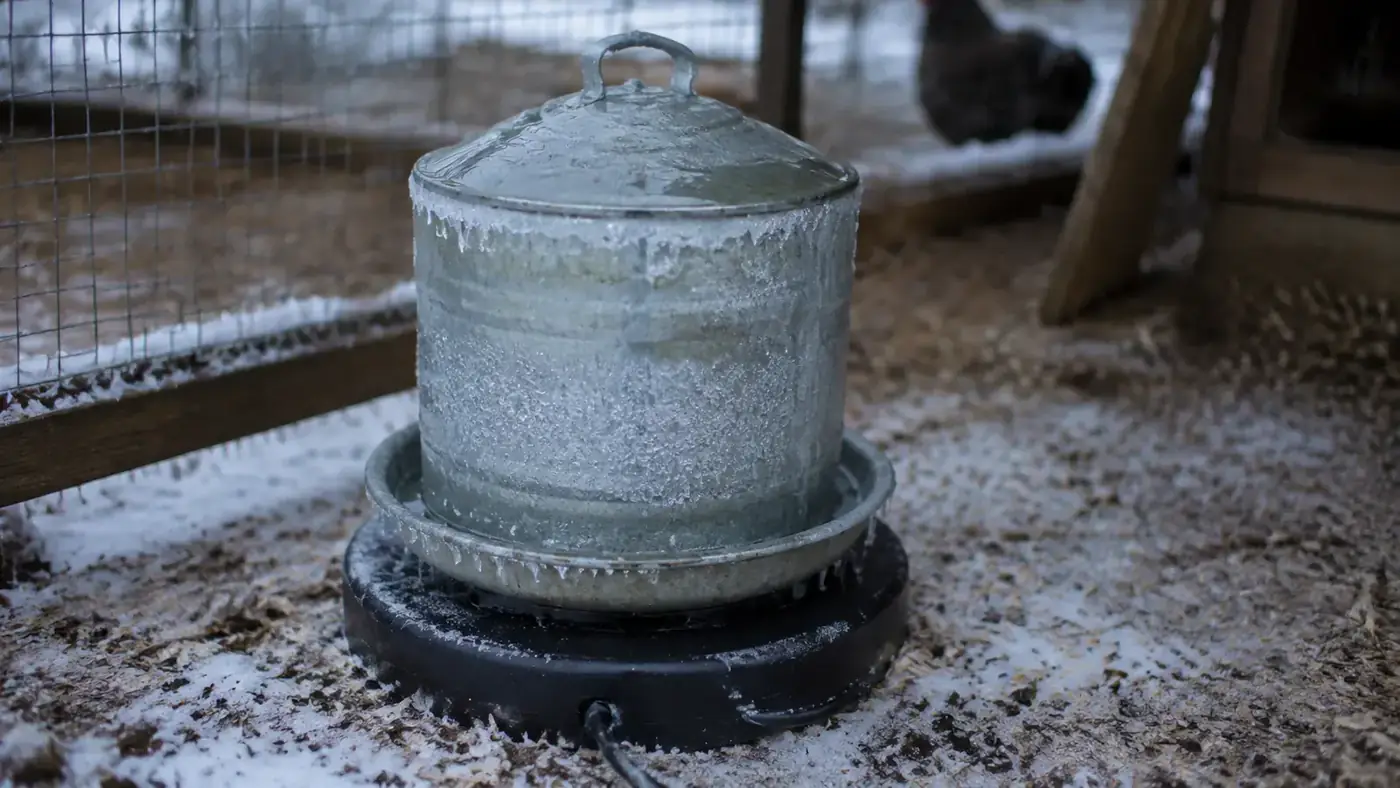
That integration matters a lot once you get below 10 degrees. I ran both setups side by side in my coop during a cold snap two winters ago when we had four consecutive nights at minus 8 to minus 14. The Farm Innovators kept liquid water every single morning. The API base setup, running a 3-gallon galvanized metal font that was sold as compatible, had a thin skim of ice forming on the surface by 4am on the third night. The base was working fine and drawing its full wattage. The problem was heat conduction from the base platform through the metal font to the water surface. Once air temps drop that far, a base-only system is fighting physics. The Farm Innovators does not have that fight because the heat source is already inside the water column.
Energy efficiency is a secondary win, but worth noting over a full season. The Farm Innovators draws 100 watts. Most generic heated bases draw 150 to 250 watts, and they are heating the platform and the surrounding air and the bottom of the metal font, not the water directly. I run the Farm Innovators on a timer that shuts off once the coop climbs above 40 degrees during the day, and it still keeps water liquid every morning through our coldest stretches. My electric bill notices the difference compared to the winters I ran the higher-wattage base setup.
Where the API Base Setup Wins
I will give the API heated base its fair credit. If you already own a quality galvanized metal poultry fountain, adding a heated base is the cheapest path to winter watering. The font itself is typically sturdier than molded plastic, and the large-capacity metal fonts at 5 to 8 gallons let you skip watering days in a way a 3-gallon unit simply cannot. For a big flock of 20 or more hens, that matters. If you are in a climate where your overnight lows rarely drop below 20 degrees, the base setup works fine. It is adequate for the mid-Atlantic and Pacific Northwest. It is not adequate for the northern plains, upper Midwest, or anywhere that sees sustained stretches below zero.
The other real case for a heated base is the long-term durability of the font. Galvanized metal lasts longer than plastic under UV exposure and freeze-thaw cycling. The Farm Innovators unit has a plastic waterer body, and after three winters I have some UV crazing on the outer walls and one small stress crack near the fill port that I sealed with food-safe epoxy. The unit still works perfectly, but I expect to replace the plastic body eventually. A galvanized metal font on a heated base might outlast the plastic option by several years if you treat it well and store it properly in the off-season.
Tired of finding ice in your waterer at 6am? The Farm Innovators keeps water liquid down to minus 10.
Over 6,400 reviews on Amazon. 4.2 stars. This is the heated waterer I have trusted for three hard Minnesota winters and counting. Check the current price and see if it ships to you.
Amazon Check Today's Price on Amazon →Real-World Performance: Three Winters of Data
My worst test case was a polar vortex that dropped our overnight lows to minus 22 for two nights in a row. The Farm Innovators was drawing 100 watts and the coop had no supplemental heat, just the normal body heat from 11 hens and decent wall insulation. I checked the waterer at 5:30am on both mornings. Both mornings, liquid water. I could hear the thermostat clicking on when I walked through the door. My hens had access to open water all night, which matters more than most people think. Dehydration during a hard freeze is a real metabolic stress on a laying flock, and hens that are mildly dehydrated overnight lay smaller eggs with thinner shells the next day.
The API base I had at that time, running a 3-gallon galvanized font, froze partially on the second night of that same cold snap. Not solid, but the surface had a quarter-inch skin of ice by 5:30am. My hens could break through it if they tried hard enough, but that is not what I bought the setup to deliver. I retired that combination after that winter and have not looked back.
One honest negative on the Farm Innovators: the plastic filling port on top can crack if you try to force it open while the waterer is frozen in place. I learned this the hard way in year two when I tried to twist the cap off without unhanging the unit first. The trick is to unhang it, carry it inside to the mudroom, let it sit for five minutes, then fill. Once I built that small habit into my morning routine, no more cracking. But it is a real vulnerability of the plastic construction that a metal font does not share, and you should know about it before your first hard freeze hits.
Both mornings at minus 22, liquid water. My hens didn't even seem to notice it was the coldest week of the year.
Setup, Daily Use, and the Stuff Nobody Mentions
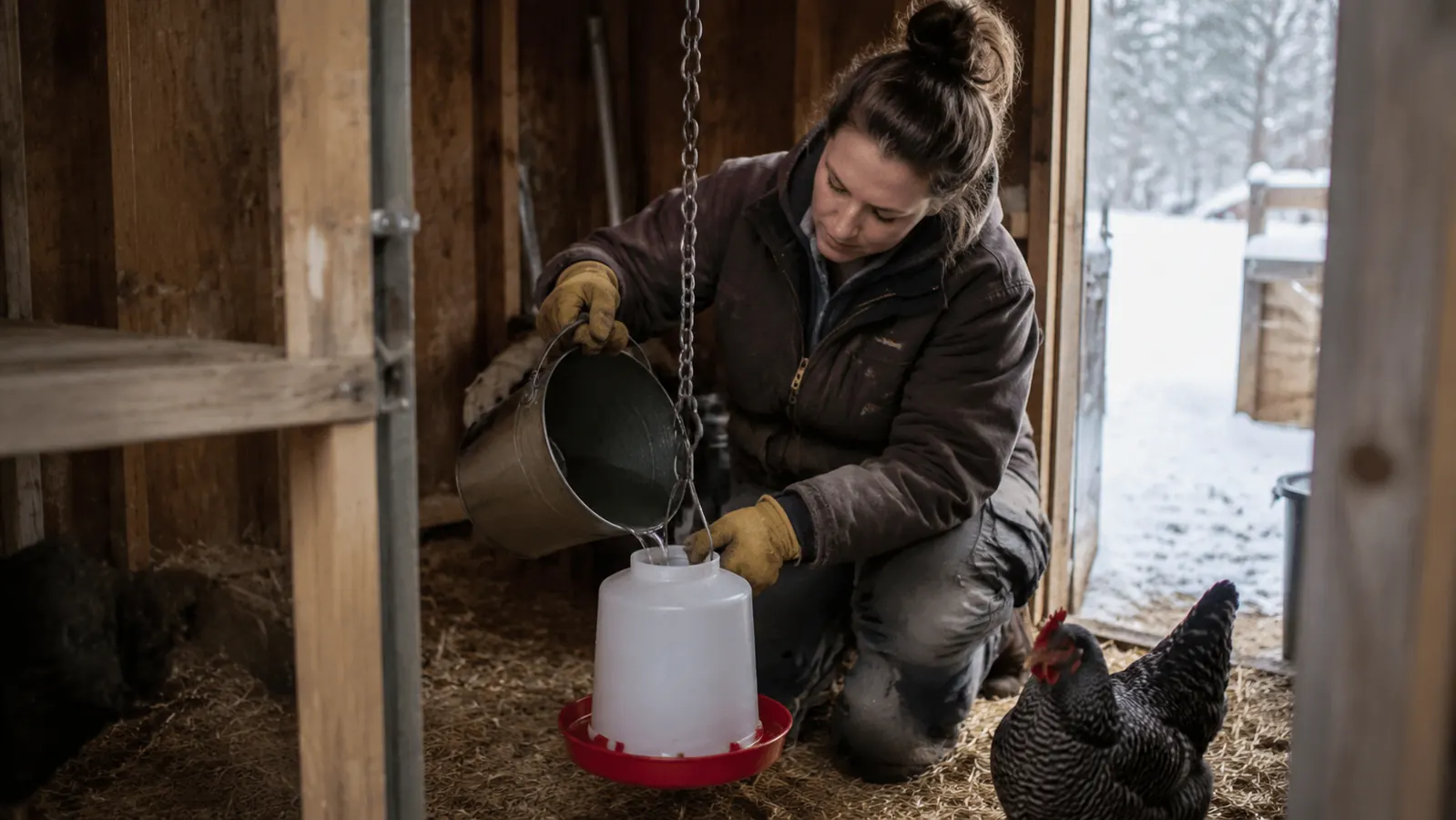
The Farm Innovators hangs from a chain or rope at the height of your shortest hen's back, roughly 10 to 12 inches off the ground for a standard-sized hen. Filling is the biggest friction point with any hanging waterer. You unhang it, fill through the top port, flip it upside down, re-hang. With a 3-gallon unit and 11 hens, I refill every two days in winter because cold hens drink less than summer hens. In the warmer months I switch to a non-heated gravity waterer and the Farm Innovators goes into storage until around October.
The API base setup has a slight ergonomic edge for filling because many metal fonts have a removable top lid that lets you fill without unhanging or flipping the unit. You just pull the lid, pour in water, replace the lid. That is genuinely more convenient on a cold morning when your hands are stiff. But convenience is a minor factor when the unit cannot reliably keep water from freezing on the nights that actually matter.
One setup note that applies to both options: run your power cord through a cord protector or wrap it in wire conduit inside the coop. Chickens will investigate and peck at anything that dangles or looks interesting, and a frayed extension cord in a straw-bedded coop is a fire hazard you do not want to think about in February. I use a 12-gauge extension cord rated for outdoor use, run it along the wall at height with plastic staple clips, and keep the junction point where the cord meets the waterer above the roost line and out of beak range. Eight years, zero incidents.
Who Should Buy Which
Buy the Farm Innovators if you are in USDA hardiness zones 4 or colder, if your overnight lows regularly hit single digits or below, or if you have already had a base-and-font combination fail on you during a hard freeze. It is also the right call if you want the simplest possible setup with the fewest moving parts and variables. You hang it, plug it in, and trust it. That is exactly what I want at 5:30am in January when it is minus 10 outside, my barn coat is barely keeping up, and I have nine other morning chores to get through before I have to be at work.
Consider the API heated base route if you are in a milder climate, roughly zones 6 and warmer, where minus 20 is not a scenario you will actually face. It also makes sense if you already own a quality galvanized metal font you want to extend rather than retire, or if you are watering a large flock and genuinely need more than 3 gallons between refills. The base-and-font combination is also more field-repairable in a pinch. If the base heating element dies, you replace just the base. If the Farm Innovators element fails, the entire unit needs replacing.
For most backyard keepers reading this, especially anyone in the upper Midwest, New England, or the mountain West, the Farm Innovators is the right answer. The integrated design, the proven performance in extreme cold, the 6,400-plus Amazon reviews backing it up, and the no-fuss setup make it the choice I would make again if I were starting from scratch. And I have started from scratch twice now, once after a waterer cracked and once after a base element failed. Both times, I went back to the Farm Innovators. That should tell you something.
If you are in a cold climate, this is the waterer I would put in your coop tonight.
The Farm Innovators 3-Gallon Heated Waterer is self-contained, thermostat-controlled at 100 watts, and rated to keep water liquid well below zero. It is the most reviewed heated waterer on Amazon for a reason, and the current price makes it a straightforward call.
Amazon Check Today's Price on Amazon →