
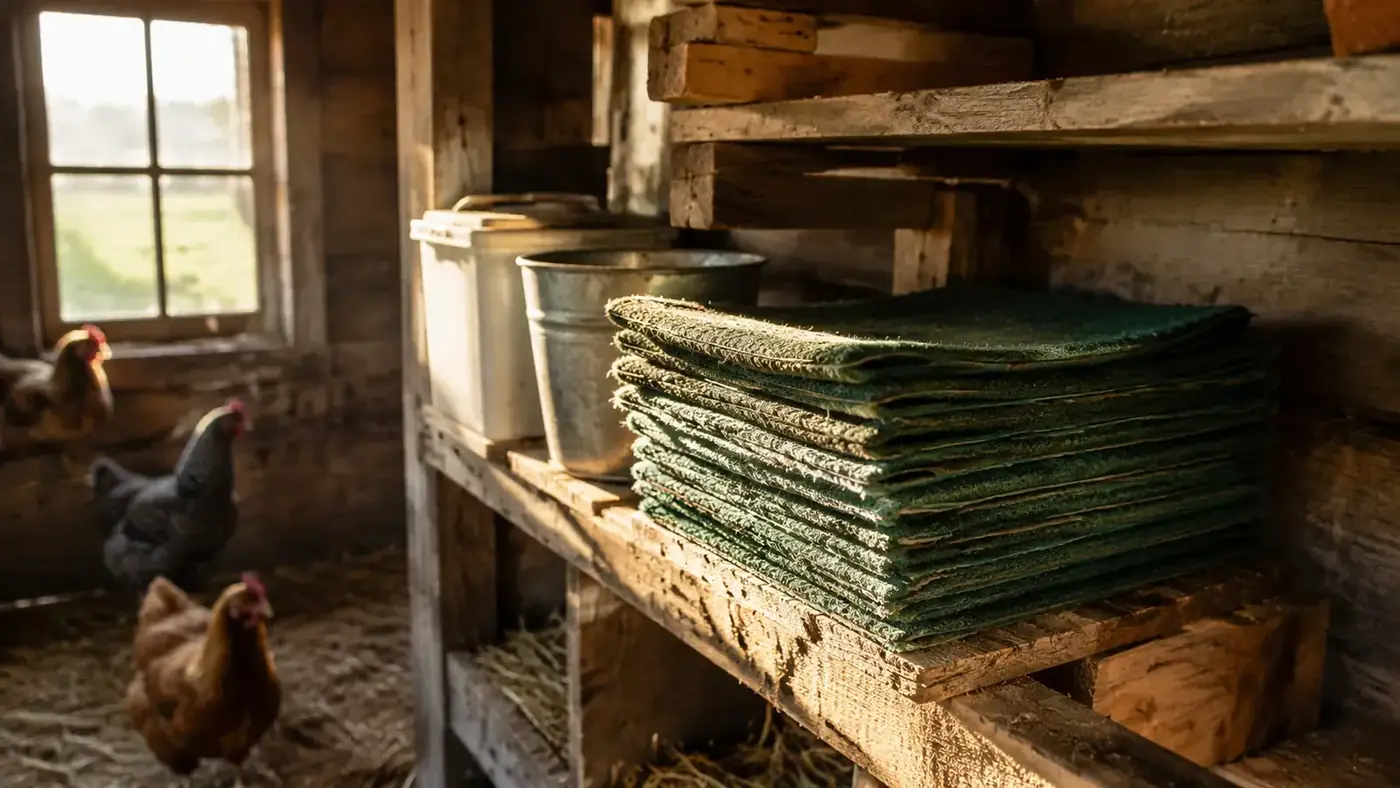
I want to be straight with you about something. The other review on this site covers six months of egg data and the general case for nesting pads over pine shavings. This one covers the stuff that review leaves out. Specifically: how often you actually replace these things, why a 13x13 pad does not fit every nest box the same way, what a broody hen does to one in three weeks flat, and the bumblefoot question that nobody in the product reviews addresses. If you want the highlight reel, that other article has it. This one is for the people who want to know what they're actually signing up for.
I have six nest boxes in my main coop, all occupied by a rotating cast of nine hens. I've run Precision Pet nesting pads in all six boxes since last October. Three of my boxes are in a store-bought coop with 12-inch square openings. Three are in a section I built myself where I bumped the boxes out to a full 14 inches square. The fit story is very different between those two sets, and I'll walk you through both.
The Quick Verdict
A genuinely useful product with a lifespan and fit caveat the listing undersells. Buy them knowing you'll replace them more often than the packaging implies, and measure your boxes before ordering.
Amazon Check Today's Price →Your hens are laying on whatever's in that box right now. Make it something that rinses clean.
Precision Pet nesting pads ship fast and are usually cheaper per pad than a bag of shavings once you factor in how long they last in a standard box. Check the current price and quantity options before you stock up.
Amazon Check Today's Price on Amazon →How I've Actually Used These
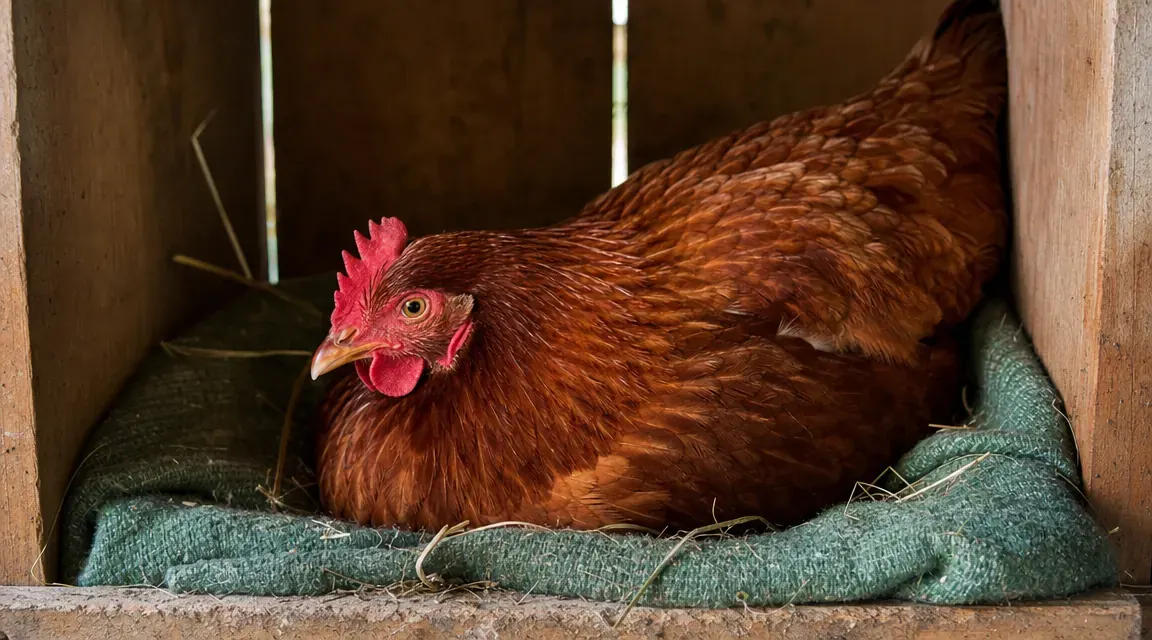
I started with a single 10-pack in October, which gave me enough to line all six boxes and keep four in reserve. My hens range in size from a Bantam Cochin who barely tips the scale at 3 lbs to a Black Australorp named Vera who is, diplomatically, a large bird. The pad goes in flat, the hen steps in, turns around twice, and settles. Most of them accepted the pads immediately. One Buff Orpington, Ruthie, spent three days scratching at the pad like it had personally wronged her before giving up and laying normally. Standard chicken logic.
My routine is simple: pull the pad, shake off any loose material over a bucket, hit it with the hose, let it air-dry on the fence rail, and rotate a dry pad back in. That cycle works well for about five to six weeks on a pad that's seeing one or two hens a day. After that, the pad starts to compress in the center and the edges fray slightly. It still functions, but you can feel the difference when you press on it. By eight weeks, most of my pads were noticeably thinner and I was replacing them.
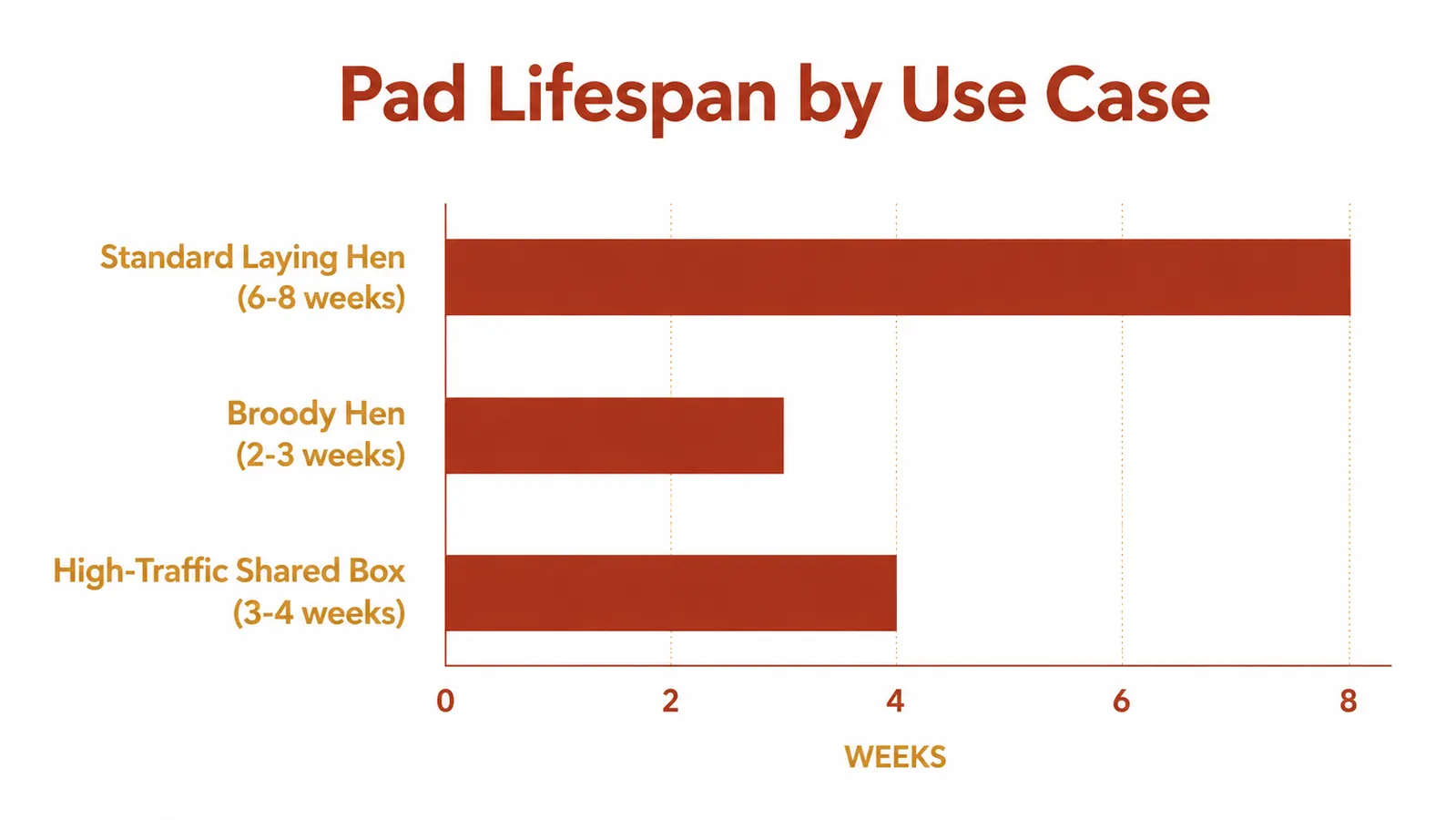
The listing says the pads are "10x reusable." That language is doing some work. Technically, yes, I washed each one more than ten times before it became compost. But the pad after ten washes is not the same pad you started with. Compression is real. If your standard for "usable" is "still holds some shape and cushion," you'll get about six to eight weeks of actual service in a standard laying box before it needs to go.
The Fit Problem Nobody Talks About
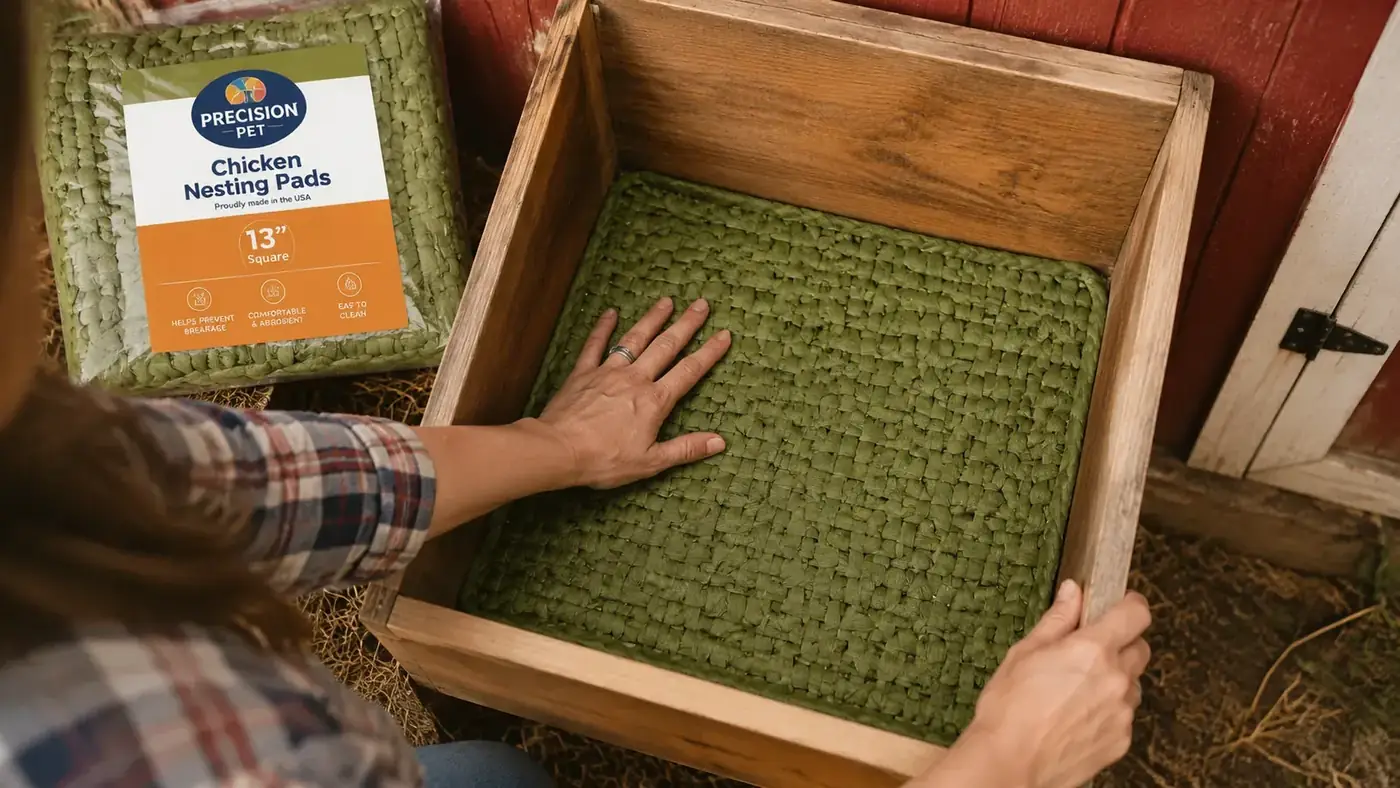
Precision Pet's pads are listed at 13 inches by 13 inches. That measurement is accurate. The problem is that nest boxes are not standardized. Store-bought coops often run 12 inches square inside the box, which means the pad is technically an inch too big per side. In practice, the pad folds up slightly at the edges and the hens flatten it down. It still works, but you lose the clean flat surface you're paying for, and a folded edge becomes a ledge that catches debris and starts to smell faster than the rest of the pad.
My custom-built boxes at 14 inches square have the opposite problem. The pad sits flat with a small gap around the perimeter. Eggs can slide toward the gap and occasionally crack against the wood wall. I put a thin strip of leftover cedar trim around the inside back edge to create a lip, which solved it, but that's a fix I had to invent myself. If your boxes are 12 inches, know the pad will curl at the edges. If your boxes are significantly larger than 13 inches, you'll want something underneath the pad to keep eggs from migrating. I'll cover that below.
The sweet spot is a box that's actually 13 inches or very close to it. If you're building a new coop or adding nest boxes, 13 inches is a better interior dimension than the common 12 anyway, since most laying breeds appreciate a little more room. Building to 13 inches and dropping these pads straight in is a clean setup.
What a Broody Hen Does to These Pads
In March, my Speckled Sussex, Pearl, decided she was going to be a mother whether I liked it or not. She went broody in one of my center nest boxes and sat there for 22 days. A broody hen does not gently rest on a pad. She presses down with the full weight of her body, shifts minimally, and generates a significant amount of heat. At the end of Pearl's sit, the pad in her box was compressed flat to about a quarter of its original thickness. The edges were intact. The center was essentially a mat.
I replaced that pad after the hatch. I expected this, and I'd budgeted for it. But I want to be clear: a pad that goes under a broody hen has a lifespan of two to three weeks, not six to eight. If you have hens who go broody regularly, factor that into your purchase quantity. I now keep a slightly larger reserve stock than I did when I started. The pad is not doing anything wrong. It's just physics. A 7-lb hen sitting still for three weeks will compress anything.
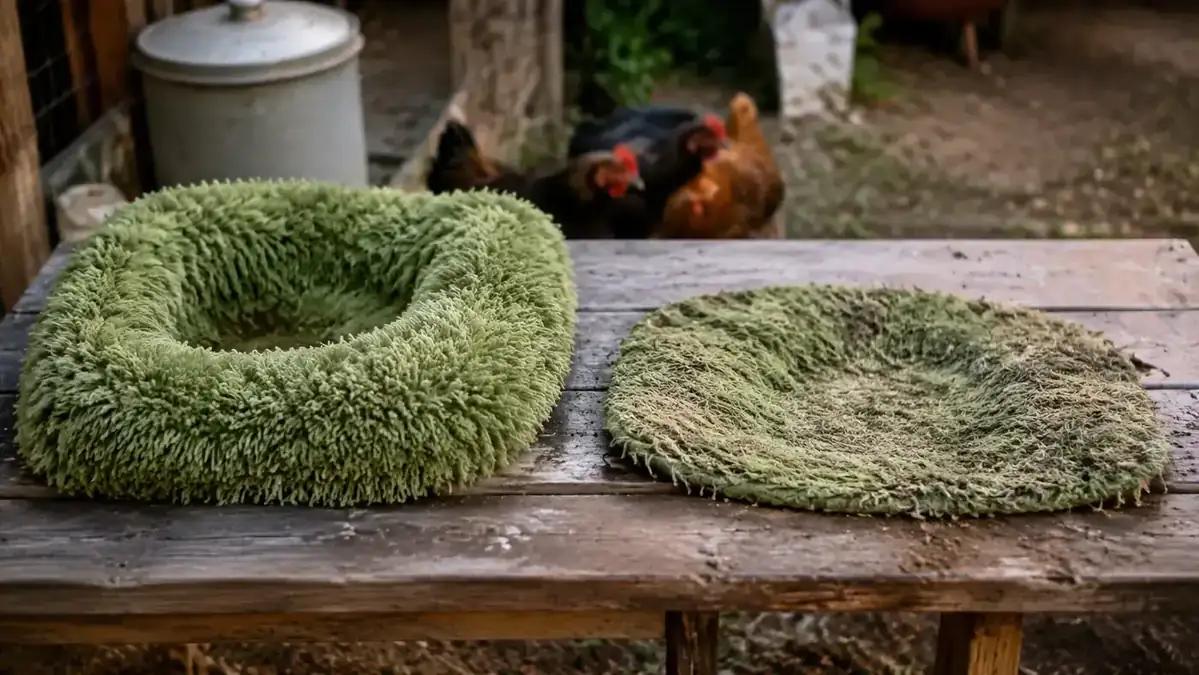
A pad that goes under a broody hen for three weeks comes out looking like it's been through a winter. That's not a defect. That's a hen.
The Bumblefoot Question
I've seen this come up in chicken forums and I want to address it directly because I couldn't find a satisfying answer when I was researching pads myself. Bumblefoot is a staph infection that enters through cuts or abrasions on the footpad, often aggravated by rough or hard surfaces. Some keepers worry that a compressed pad is harder on feet than fresh shavings, and they've asked whether nesting pads could be a contributing factor.
Here's my honest read: the pad surface when new is soft enough that I wouldn't flag it as a bumblefoot risk. A pad that has been washed many times and compressed significantly is firmer, but it's still not rough. The bigger bumblefoot risk factors are high roost heights, wire flooring, and general coop hygiene, not a slightly compressed nesting pad. That said, I wouldn't leave a very worn pad in rotation past the point where it has lost most of its cushion. Once you're pressing on it and feeling hard backing, it's time to rotate it out. My practical rule is to replace any pad that's lost more than half its original loft.
None of my nine hens have developed bumblefoot in the six months I've run these pads, including Vera, my large Australorp who is hard on every surface she touches. I don't attribute that entirely to the pads, but I also don't see any evidence the pads are creating a problem. Clean pads in regular rotation appear to be a net positive for foot health compared to wet, compacted shavings.
What to Put Underneath
The pad is not a perfect seal against a bare wood box. In a wet stretch, condensation or a small amount of moisture from a hen can get under the pad and soak into the wood. Over time, that causes the same rot and smell problems that shavings do if you're not careful. I now put a thin layer of hardware cloth or a cut piece of rubber shelf liner under the pad in each box. The shelf liner is my favorite solution. It's cheap, it washes easily, it creates a small air gap that lets the underside of the pad dry faster after washing, and it gives the pad something grippy to sit on so it doesn't shift when a hen scratches at it.
Some keepers put a thin layer of shavings or pine pellets under the pad as a moisture buffer. That works but it defeats some of the simplicity that makes the pads appealing in the first place. The shelf liner approach keeps the setup clean and fast to maintain. A dollar-store pack of cut-to-fit shelf liner will outlast several pad rotations.
What I Liked
- Rinses clean in under a minute with a hose, no scrubbing required
- Significantly fewer mite hiding spots compared to loose shavings
- Hens accept them immediately in most cases, no transition period
- Egg breakage dropped noticeably compared to bare shavings in my boxes
- Dry fast on a fence rail or in sunlight, back in rotation the same morning
- Firm enough that eggs do not sink or roll once a hen sets them
Where It Falls Short
- The 13x13 size does not fit a 12-inch box flat, edges fold up
- Broody hens compress a pad to nearly flat in two to three weeks
- "10x reusable" oversells actual useful lifespan, expect six to eight weeks in standard use
- No moisture barrier underneath, needs a shelf liner or similar under it
- Very large boxes (over 14 inches) leave a gap that eggs can drift into
- Per-pad cost is higher upfront than a bag of shavings, though comparable over a season
Who This Is For
You're going to get the most out of these pads if your nest boxes are close to 13 inches square, you have a manageable flock size where rotating and drying pads is realistic, and you care more about egg cleanliness and mite control than you care about having the cheapest possible bedding option. Keepers who have dealt with persistent mites in loose shavings will find the switch particularly satisfying. There is simply less material for mites to nest in, and a wet pad wipes down and dries in a way that loose bedding never does. If egg cleanliness is your main frustration, these pads will make a visible difference within the first week.
Who Should Skip These
Skip them if your nest boxes are significantly smaller than 12 inches. A pad crammed into a too-small box is uncomfortable for a small-breed hen and creates a bunched-up mess that's harder to clean than shavings. Skip them if you have a large flock and more than eight nest boxes, unless you're prepared to invest in a meaningful supply and have a consistent rotation schedule. Running out of dry pads and putting wet ones back in is worse than shavings. Skip them if one or more of your hens go broody multiple times a season and you're on a tight budget. The pad cost adds up faster than you'd expect when a broody hen is involved. And skip them if you run deep-litter method in your boxes. These pads are not designed to live at the bottom of a deep litter setup. They're designed to be pulled, washed, and returned. If that's not how you run your coop, they're the wrong tool.
If your boxes are close to 13 inches and you're tired of shaking shavings out of eggs, these are worth a single pack to try.
Order one 10-pack, run them for six weeks, and see how your boxes compare. The rinse-and-dry cycle will tell you quickly whether this fits how you manage your coop. Check the current price on Amazon before you decide.
Amazon Check Today's Price on Amazon →